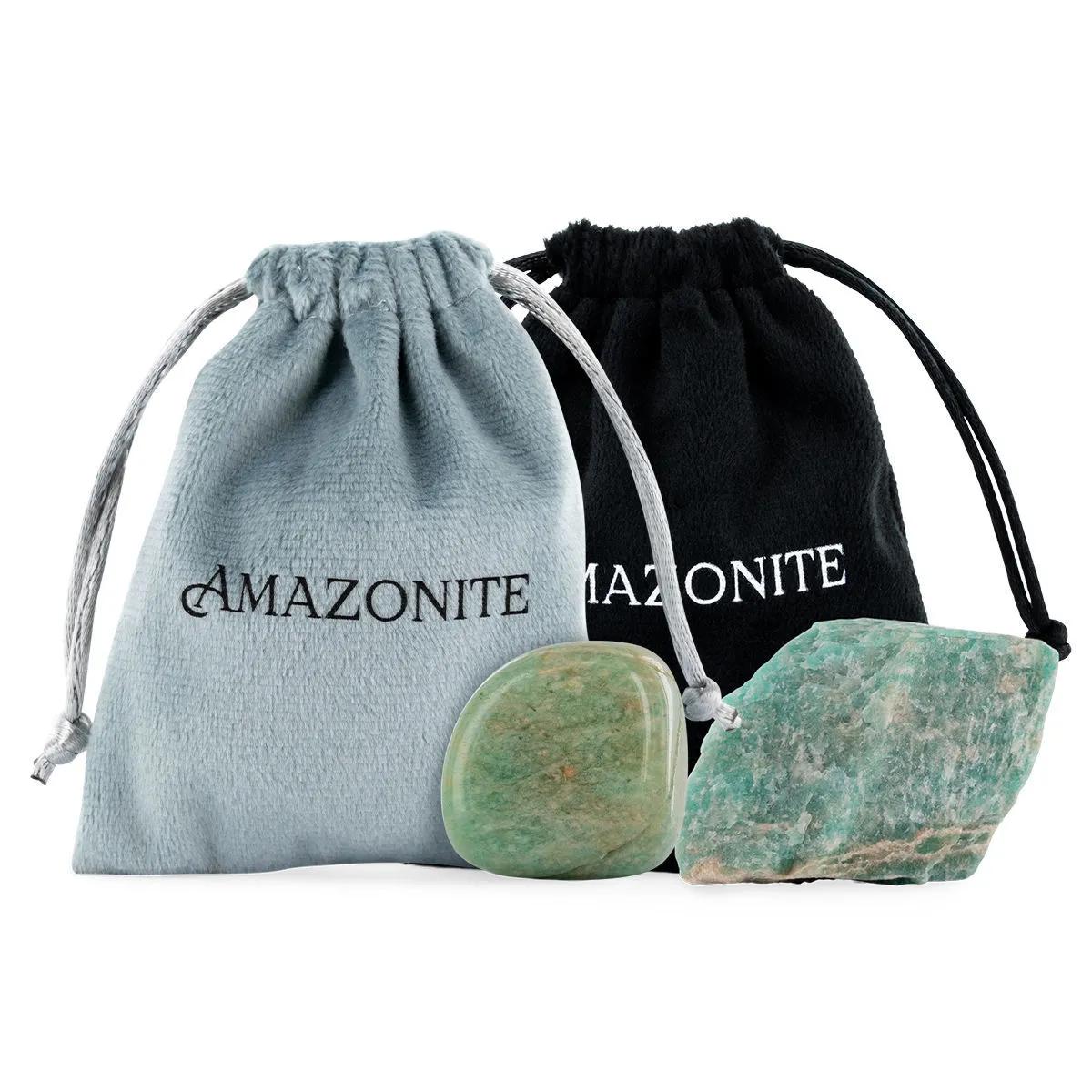
Amazonite is a blue-green feldspar crystal that has been used for over 5,000 years across Egypt, Mesopotamia, India, and the Americas — prized today as a "peacemaker stone" associated with the throat and heart chakras. We carry it in two finishes (Natural and Polished), each piece sized between 3 and 5 cm, making it a pocket-friendly companion stone or a desk anchor for anyone drawn to its calming aesthetic.
Why Amazonite earns its keep
Amazonite is the crystal people reach for when they want a stone that looks as good on a windowsill as it does in a pocket. The blue-green colour comes from trace lead and water within the microcline feldspar structure — and according to the journal Geochemistry and Cosmochemistry of Potassium Stable Isotopes (PMC, 2022), amazonite-bearing pegmatites are among the few igneous formations showing measurable potassium isotope fractionation. Translation: this stone has a genuinely unusual mineralogy, not just a pretty face.
The cultural history is just as solid. Research published in Lakeside Cemeteries in the Sahara: 5000 Years of Holocene Population and Environmental Change (PMC, 2008) documents amazonite use in the central Sahara as far back as the Neolithic, where the green stone was worked into tools, beads, and burial ornaments. Similar finds appear in the study Green stone beads at the dawn of agriculture (PMC, 2008), which traces green-stone bead traditions across the Levant from the Natufian period onwards. People have been carrying this stone around for a very long time.
The modern attraction is more emotional than archaeological. In the crystal-healing tradition, amazonite is associated with the throat chakra (clear communication) and the heart chakra (compassion). According to Healthline's overview Do Healing Crystals Work? Lore, History, Research (Healthline, 2020), many people use crystals like amazonite for stress, focus, and as part of a mindfulness practice — the article is honest about the lack of clinical evidence, but equally clear that the ritual and intention-setting around crystals can be a real part of someone's self-care toolkit.
Natural vs Polished: which Amazonite variant to pick
Both variants are the same mineral from the same sources — the difference is finish, not quality. Pick based on how you want to use it.
| Variant | Look & feel | Best for | SKU |
|---|---|---|---|
| Natural | Raw, unpolished surface. Visible cleavage planes, matte finish, irregular shape. Each piece looks distinctly different. | Altar pieces, grid work, people who want the stone "as it came out of the ground" | SM0772 |
| Polished | Tumbled smooth, glossy finish, rounded edges. Colour reads more vivid because light reflects off the polished surface. | Pocket carry, meditation in hand, gifts, anyone who wants the smooth tactile feel | SM0773 |
Size note: Every piece falls between 3 and 5 cm at its longest dimension. Because amazonite is sold by individual specimen, the exact shape, banding, and intensity of green-blue varies from stone to stone — we can't pick a specific pattern for you, but we can promise none of them are duds.
How to use Amazonite in a daily practice
There's no single "correct" way to work with amazonite — but here's what people who actually use crystals tend to do with it.
- Cleanse it first. Run it under cool water for 30 seconds, or leave it on a windowsill in indirect moonlight overnight. Skip salt water and direct strong sunlight — feldspars can fade over time with intense UV exposure.
- Set an intention. Hold the stone, name what you want to work on (a difficult conversation, a boundary you need to hold, calmer self-talk). One sentence is enough.
- Carry it where you'll feel it. Pocket, bra strap, bag — somewhere your hand will brush against it during the day. The Polished variant is the more comfortable carry.
- Pair it with the conversation. Many users place a piece of amazonite in their pocket before a difficult talk, or rest it on the desk during a tense email exchange.
- Recharge weekly. Rinse, dry, and re-set your intention. Once a week is plenty.
From our counter: what people actually ask
We get the same three questions about amazonite, almost word for word. First: "Is it real?" — yes, all our pieces are natural microcline feldspar, not dyed howlite (which is the common knock-off you'll find on market stalls). Second: "Why is one piece more blue and another more green?" — trace element variation in the original deposit; both are genuine amazonite. Third: "Will it actually do anything?" — see the honest limitations section below.
Honest limitations
We sell crystals because people love them, not because we're going to tell you they're medicine. According to Healthline's Healing Crystals 101 guide (Healthline, 2020), the research base for crystal healing is essentially anecdotal — the documented benefits people report tend to track with placebo, mindfulness, and the act of intentional ritual rather than the stone itself. That doesn't make the practice worthless; mindfulness and intention-setting are well-established as supportive practices in the systematic review Integrative and complementary practices in health (PMC, 2023). But if you're dealing with serious anxiety, communication difficulties at work, or relationship breakdown, amazonite is a companion piece — not a substitute for a therapist, a GP, or an honest conversation.
Also: don't drink crystal elixirs made from amazonite. You'll see "amazonite elixir" recipes online suggesting seven drops three times a day — we'd skip that entirely. Feldspar minerals can contain trace lead and other elements you don't want leaching into drinking water. Use the stone externally, full stop.
Amazonite pairs naturally with other communication and heart-centred stones. If you're building a small collection, Rose Quartz (heart chakra, self-compassion) and Sodalite (throat chakra, mental clarity) round out the set nicely. A small velvet pouch keeps polished pieces from getting scratched in a bag.
Specifications
| Mineral | Amazonite (microcline feldspar variety) |
| Colour | Blue-green, varies piece to piece |
| Size | 3–5 cm at longest dimension |
| Variants | Natural (SM0772) / Polished (SM0773) |
| Hardness (Mohs) | 6 – 6.5 |
| Associated chakras | Throat, heart |
| Care | Rinse with cool water; avoid prolonged direct sunlight and salt |
| Sold as | Single piece, individually selected |
Frequently Asked Questions
Is Amazonite safe to wear?
Yes — amazonite is safe to wear and carry. The stone is stable, non-toxic to the touch, and ranks 6–6.5 on the Mohs scale (similar to most jewellery-grade stones). Avoid making drinking elixirs from it, since feldspar can contain trace metals, and don't leave it in salt water as that can damage the surface over time.
How do I tell real Amazonite from dyed howlite?
Real amazonite has uneven, mottled colour with white streaks of albite feldspar running through it — never a perfectly uniform turquoise shade. Dyed howlite, the common fake, looks suspiciously even and shows colour bleeding when scratched. All our pieces are genuine natural microcline feldspar.
What are the benefits of Amazonite chakra stones?
In the crystal-healing tradition, amazonite is associated with the throat and heart chakras — used as a meditation focus for clearer communication, calmer dialogue, and self-compassion. According to Healthline (2020), these benefits sit in the area of mindfulness practice and intention-setting rather than clinical effect, so use it as a ritual aid alongside (not instead of) other tools.
How should I use Amazonite during a difficult conversation?
Place a polished piece in your pocket before the conversation starts, or rest it on the desk where you can see it. Brushing your hand against it acts as a physical cue to pause, breathe, and stay measured. It's a mindfulness anchor — the stone itself doesn't do the talking, but it can help you remember to.
How do I clean and recharge Amazonite?
Rinse under cool running water for about 30 seconds, then dry with a soft cloth. For recharging, leave it on a windowsill overnight under indirect moonlight, or rest it on a bed of dry hematite or selenite. Skip salt water (damages the surface) and intense direct sun (can fade the colour over time).
Natural or Polished — which should a first-time buyer pick?
If you want to carry it daily or hold it during meditation, go Polished — the smooth tumbled finish feels better in the hand and shows off the colour. If it's going on an altar, shelf, or crystal grid where you want a more "raw" look, go Natural. Both are the same mineral; it's purely a finish preference.
Last updated: April 2026