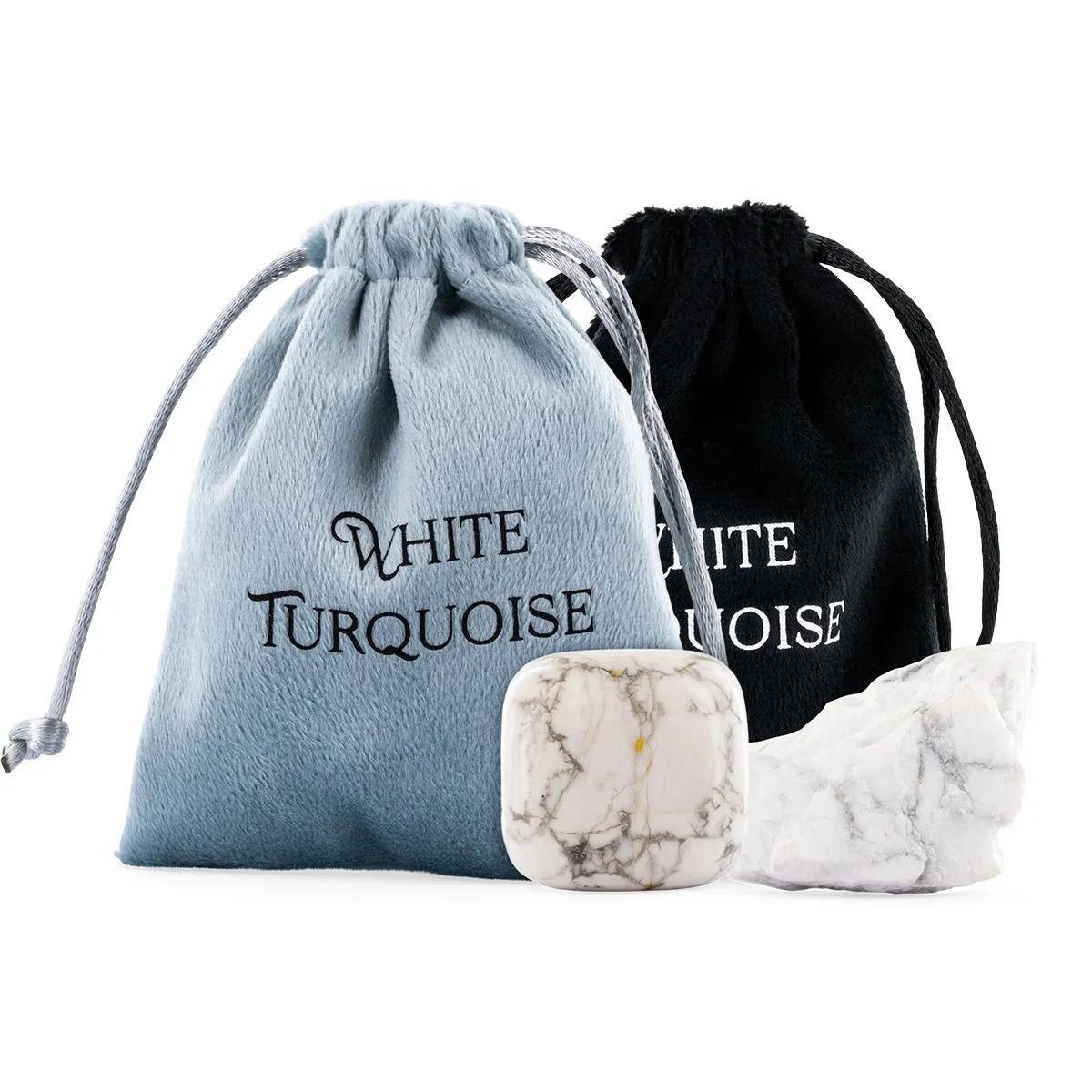
White Turquoise is a calcium-borosilicate mineral that brings a striking white-and-grey marbled surface to any crystal collection. Also known as White Buffalo Turquoise or White Howlite Turquoise, it forms in the veins of igneous rocks through slow geological processes — which is why no two pieces ever look quite the same. We carry it in two finishes (natural and polished) and in tumble-friendly sizes between 3 and 5 cm.
What makes White Turquoise worth shelf space
White Turquoise stands out because it isn't really turquoise in the copper-mineral sense — it's a calcium-borosilicate stone with the same dense, marbled character. The white base runs through with grey veining, and depending on the piece you'll see anything from soft cloud-grey ribbons to sharp charcoal webbing. It's quieter than the bright blue stuff, which is exactly why collectors keep coming back to it.
The stone has been called White Buffalo Turquoise after the mine in Nevada where similar material is pulled, and White Howlite Turquoise because of its mineralogical kinship with howlite. Whatever the name, you're looking at a stone formed over millions of years through slow mineralisation — a piece of geology you can hold in your hand.
Natural vs Polished — which finish to pick
The choice comes down to whether you want raw texture or a smooth, light-reflecting surface. Both finishes show the same white-and-grey patterning; only the feel and visual depth changes.
| Finish | What you get | Best for |
|---|---|---|
| Natural (SM0777) | Raw, untreated surface with visible mineral texture and matte tone | Display pieces, altar stones, anyone who likes to see the geology |
| Polished (SM0778) | Smooth, glossy finish that deepens the grey veining and catches light | Pocket stones, meditation work, jewellery-adjacent setups |
If you can't decide, the polished version travels better — the smooth surface won't snag on pocket linings or fabric pouches. The natural finish wins on display shelves where you want the stone to look like it just came out of the ground.
Specifications
| Mineral type | Calcium borosilicate (White Turquoise / White Buffalo / White Howlite Turquoise) |
| Size range | 3–5 cm |
| Finishes available | Natural, Polished |
| Colour | White base with grey accents and veining |
| Origin | Veins of igneous rock formations |
| Care | Wipe with a damp cloth |
| SKUs | SM0777 (Natural), SM0778 (Polished) |
Properties and traditional use
White Turquoise is traditionally associated with calm, inner peace, and a sense of grounded clarity in the space where it's placed. Crystal practitioners often keep it close — on a desk, bedside table, or in a pocket — as a quiet companion stone rather than a high-energy showpiece. We're not making medical claims here; this is the cultural and metaphysical context the stone sits in, the same way amethyst gets paired with sleep and rose quartz with the heart.
If you're new to crystals and minerals, White Turquoise is a forgiving starting point. It's visually understated, easy to live with, and doesn't demand a specific ritual setup the way some of the louder stones do.
How to care for your White Turquoise
- Wipe the surface with a slightly damp cloth — no soap, no harsh cleaners.
- Dry it off with a soft cloth before putting it back on display or in a pouch.
- Avoid prolonged water soaking — calcium-based minerals can absorb moisture over time.
- Keep it out of direct sunlight for long stretches if you want to preserve the contrast between the white and grey.
- Store loose pieces in a soft pouch so they don't knock against harder stones in your collection.
Honest limitations
A few things worth knowing before you order. First, White Turquoise is softer than copper-based turquoise — it'll scratch if you drop it on a tile floor or rattle it around in a bag with quartz points. Second, every piece varies. The photos give you the general look, but the exact pattern of grey veining is unique to each stone, so if you're after one specific marbling style you may want to order a couple and pick your favourite. Third, the 3–5 cm size is pocket-friendly but not display-dominating — if you want a centrepiece for a shelf, this isn't the stone for that job.
Pairs well with darker grounding stones like Black Tourmaline or Smoky Quartz for visual contrast on a shelf, or with Selenite if you like to keep your collection on a charging plate. A small velvet pouch makes the polished version a proper pocket companion.
Frequently Asked Questions
Is White Turquoise the same as real turquoise?
No — White Turquoise is a calcium-borosilicate mineral, while traditional blue turquoise is a copper-aluminium phosphate. They share a similar marbled look and are often sold under the turquoise umbrella, but mineralogically they're different stones. White Turquoise is also called White Buffalo Turquoise or White Howlite Turquoise.
What's the difference between the natural and polished finish?
The natural finish keeps the raw mineral texture with a matte tone, showing the stone the way it came out of the rock. The polished finish is smoothed and glossy, which deepens the grey veining and reflects light. Same stone, different feel.
How do I clean White Turquoise?
Wipe it with a slightly damp cloth and dry it with a soft one. Skip soap, chemical cleaners, and long water soaks — calcium-based minerals can absorb moisture over time, which dulls the surface.
Will the stone I receive look exactly like the photo?
The colour and overall character will match, but every piece has its own grey veining pattern because the mineralisation process produces unique marbling. Think of the photos as a representative example rather than the exact stone you'll get.
Can I carry White Turquoise in my pocket?
Yes, especially the polished version — the smooth surface handles daily contact better and won't snag on fabric. Keep it in a small pouch if you carry keys or coins in the same pocket, since it's softer than quartz and can scratch.
What's White Turquoise traditionally used for?
In crystal and gemstone traditions it's associated with calm, inner peace, and creating a settled atmosphere in the space where it's kept. People typically place it on a desk, bedside table, or carry it as a pocket stone. These are cultural associations, not medical claims.
Last updated: April 2026