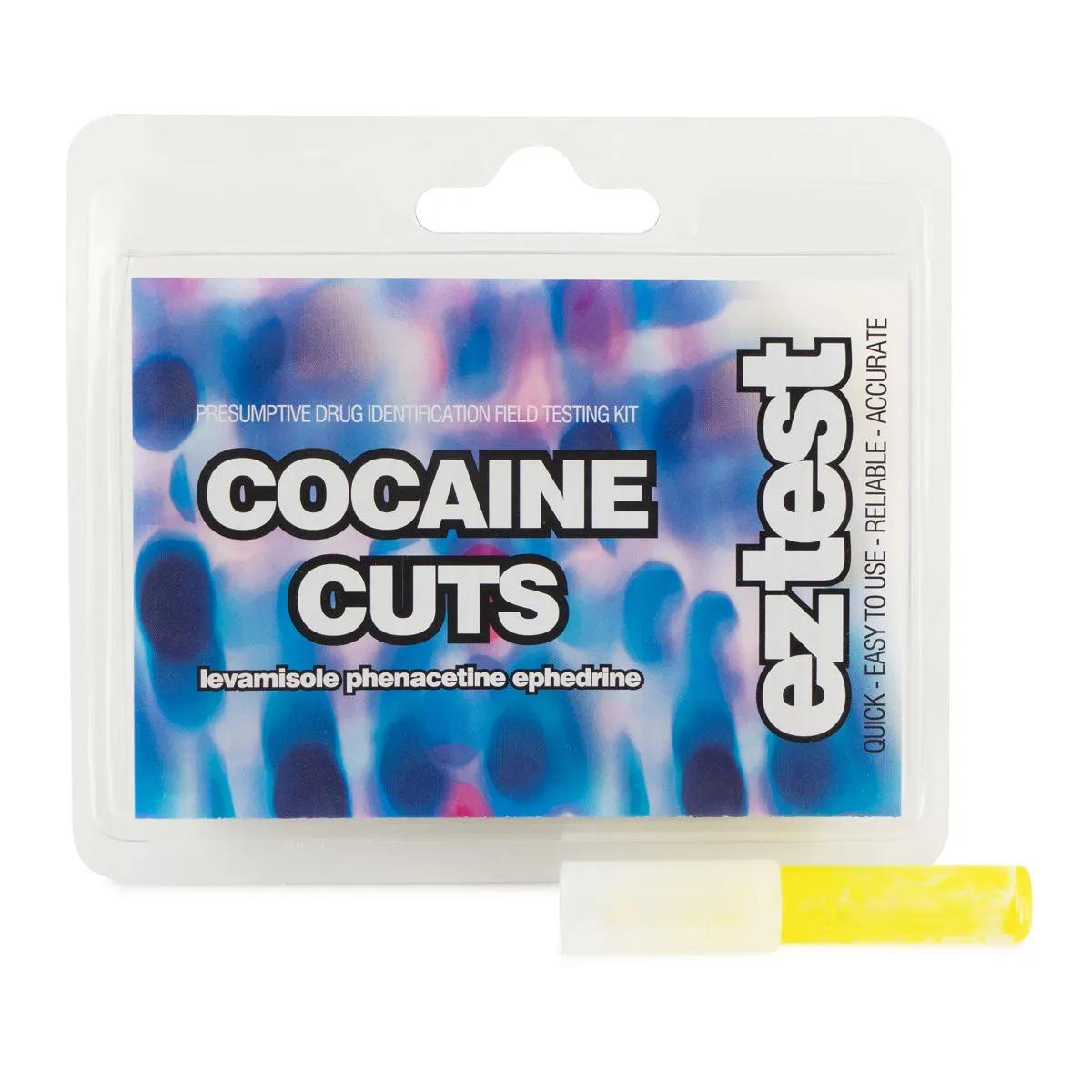
The EZ Test Cocaine Cuts is a single-step reagent kit that tells you which adulterants are hiding in your powder — specifically Levamisole, Phenacetine and (Pseudo)-Ephedrine. Drop a tiny sample into the ampoule, shake, and read the colour chart. You'll know within 30 seconds whether your dealer is honest or whether you've been paying coke prices for horse dewormer.
Why test for cuts, not just for cocaine?
Because cocaine itself is rarely the problem — what's mixed into it is. Modern street cocaine in Europe is routinely stretched with cheaper substances that bulk out the powder and mimic some of the effects. The three big ones this kit catches are the three you'll most likely encounter in 2026.
Levamisole is the headline cut. It's a veterinary anti-parasitic used to deworm cattle and horses, and according to EMCDDA monitoring data, it shows up in roughly 70% of European cocaine seizures. Long-term Levamisole exposure has been linked to agranulocytosis — a critical drop in white blood cells — in clinical case reports. Phenacetine is an old painkiller pulled from human medicine in the 1980s after kidney and bladder cancer links emerged. (Pseudo)-Ephedrine is the cheap stimulant from cold-and-flu pills, used to fake that bumpy feeling without the actual drug doing the work.
Important to know: this kit does not react with cocaine itself. It only detects the cuts. If you want to check whether the powder actually contains cocaine, or how pure it is, you'll want the EZ Test Cocaine & Crack or the EZ Test Cocaine Purity Test instead. The Cuts kit is the second layer of testing — you confirm it's cocaine with one kit, then check for adulterants with this one.
Which pack size should you pick?
1 test (SM0177) — One-off check. Good if you're testing a single batch from a new source and want to know what you're dealing with before committing.
5 tests (SM0178) — The honest middle ground. Most people who buy occasionally end up here. Tests stay good for around 2 years sealed, so you're not wasting them.
10 tests (SM0372) — Best value per test, and what we'd grab if we were testing for a group or across multiple sources. Cheapest per-test option in the range.
How the reagent test works
EZ Test Cocaine Cuts uses a colourimetric reagent sealed inside a glass ampoule. When a small sample is introduced, the reagent reacts with specific adulterants — not with the cocaine — and produces a colour change. You then match that colour against the printed chart included in the leaflet to identify which cut (if any) is present.
No pipettes, no scales, no dangerous open liquids. The reagent stays in the ampoule the entire time. Compared to lab-grade gas chromatography (the only method that's truly definitive), this is obviously a rough indicator — but for a 30-second check on your kitchen counter, it does the job most users need it to do.
Specifications
| Brand | EZ Test |
| Test type | Single-use reagent ampoule |
| Detects | Levamisole, Phenacetine, (Pseudo)-Ephedrine |
| Does NOT react with | Cocaine itself |
| Result time | ~30 seconds |
| Sample size | Small grain (matchstick-head) |
| Shelf life | ~2 years sealed, stored cool and dark |
| Variants | 1, 5 or 10 tests per pack |
| Reading method | Colour chart (included) |
Pair this with the EZ Test Cocaine & Crack Cocaine to first confirm the powder actually contains cocaine, then run the Cuts test to see what else is in there. Two ampoules, full picture. If you're testing other substances too, the EZ Test Multi covers MDMA, amphetamine, ketamine and more in a single kit.
Why you need this if you use cocaine at all
The cocaine sold in Europe in 2026 is almost never pure. EMCDDA's annual report puts average retail purity in the Netherlands around 60-70%, which means roughly a third of what you're snorting is something else. That "something else" is usually one of the three substances this kit detects. Levamisole in particular has been the dominant cut for over a decade — it's cheap, it has mild stimulant-like properties, and dealers further up the chain add it kilo by kilo.
The honest limitation: this kit won't tell you the quantity of the cut. A positive result means "yes, Phenacetine is present" — not "your powder is 40% Phenacetine". It also won't catch newer or rarer adulterants outside the three it's designed for. For that, you'd need to send a sample to a service like the DIMS testing programme in the Netherlands, which is free and anonymous and gives lab-accurate results in about a week.
What this kit does well: it's instant, it's in your hand, it costs the price of one beer, and it catches the three cuts you're statistically most likely to run into. If you're going to use cocaine, knowing whether it's mostly cocaine or mostly cattle medicine is information worth having before the powder goes up your nose.
How to use the EZ Test Cocaine Cuts
- Find a stable, well-lit surface. Daylight or a white-light lamp — coloured bulbs mess with the colour reading.
- Carefully snap open the glass ampoule using the included plastic sleeve. Don't touch the reagent with your skin.
- Drop a small sample — about the size of a matchstick head — into the ampoule. More is not better; too much sample throws off the colour.
- Close the ampoule and gently shake for a few seconds to mix the reagent with the sample.
- Wait around 30 seconds. The reagent will change colour based on what's present.
- Hold the ampoule against the colour chart in the instruction leaflet and match the result. The chart shows which colour indicates which cut.
- Dispose of the used ampoule safely — wrap in tissue, place in a sealed bag, bin it. Don't pour reagent down the sink.
Frequently Asked Questions
Does this kit tell me if my cocaine is real?
No. The Cuts kit only detects adulterants — Levamisole, Phenacetine and (Pseudo)-Ephedrine. To confirm the powder is actually cocaine, use the EZ Test Cocaine & Crack Cocaine. To estimate purity, use the EZ Test Cocaine Purity Test. Most people who test seriously own all three.
What is a cutting agent?
A cutting agent is any substance added to a drug to bulk it out, mimic its effects cheaply, or change its appearance. With cocaine, the most common cuts in Europe are Levamisole (a veterinary dewormer), Phenacetine (a withdrawn painkiller) and (Pseudo)-Ephedrine (a cheap stimulant from cold medicine).
Why is Levamisole in so much cocaine?
It's cheap, white, water-soluble, and produces a mild stimulant-like effect that masks the dilution. EMCDDA seizure data shows Levamisole in around 70% of European cocaine samples. Long-term exposure has been linked to agranulocytosis (a serious drop in white blood cells) in clinical case reports.
How long do EZ Tests last on the shelf?
Around two years if kept sealed, cool and out of direct sunlight. Heat and UV degrade the reagent faster. If the liquid inside the ampoule looks discoloured before you've added anything, the test has expired — bin it.
Is this test 100% accurate?
No, and the manufacturer is clear about that. It's a reagent indicator, not a lab assay. For scientifically certified results, you'd submit a sample to an official testing service like DIMS in the Netherlands. For a 30-second check at home, this is the best tool available at the price.
Can I use one ampoule for multiple samples?
No. Each ampoule is single-use. Once the reagent has reacted with one sample, the chemistry is spent and the result for a second sample would be unreliable. That's why we'd suggest the 5- or 10-pack if you plan to test more than once.
Last updated: April 2026