Drug tests
by EZ Test
We'll only email you about this product — no marketing.
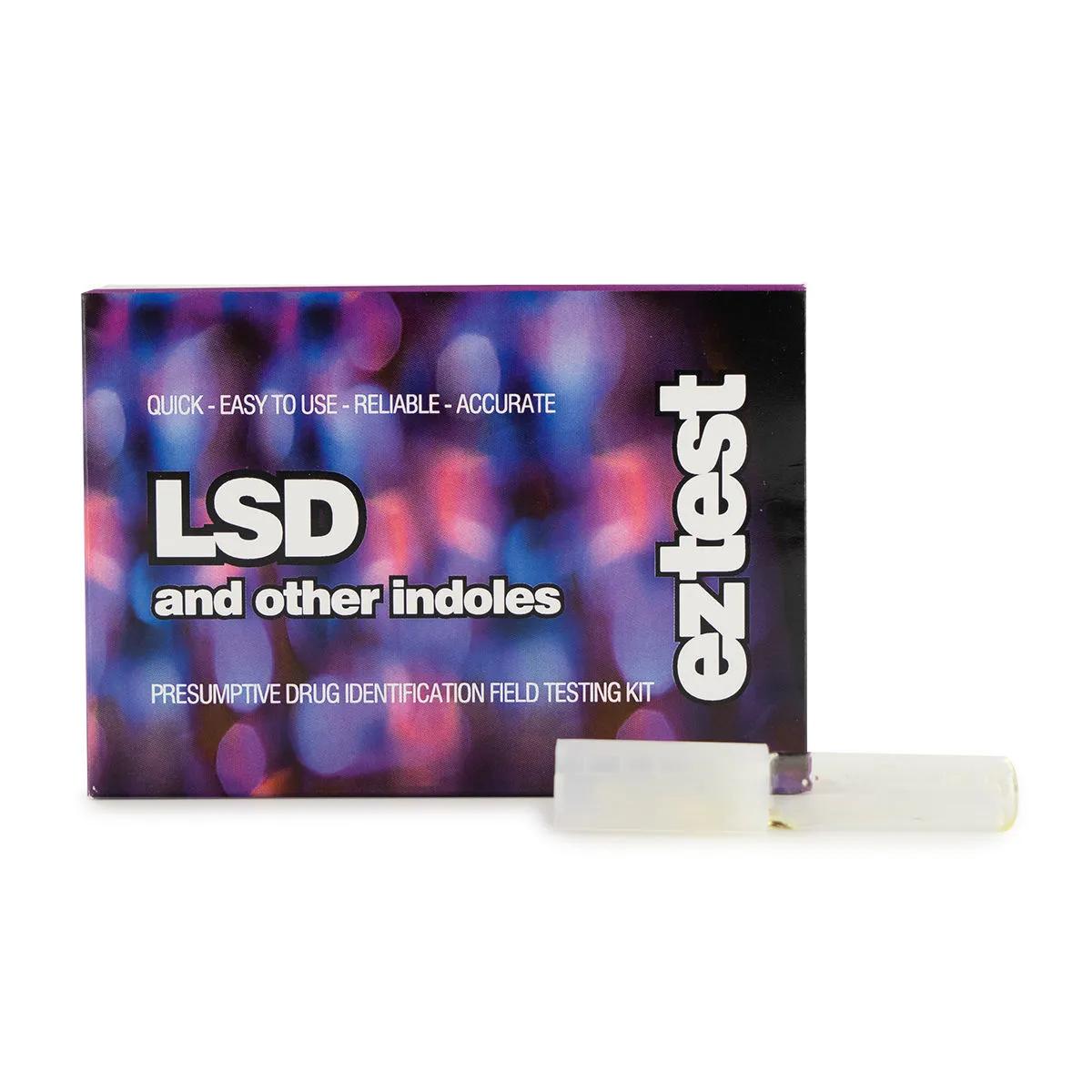
EZ Test LSD and Indoles is a single-use reagent test kit that detects the presence of LSD and other indole compounds in a sample within minutes. Drop a tiny amount of your substance into the phial, give it a gentle shake, and the colour change tells you whether indoles are present. It won't replace a full lab analysis, but it's the quickest way to check if what you've got is actually what you were told it is.
We've stocked these kits since the early days of the shop — they're one of the most-requested harm reduction tools we carry. A single phial costs less than a pint, and the peace of mind is worth considerably more.
The EZ Test LSD and Indoles kit comes in three variants: a single phial for one-off testing, a 5-pack if you test semi-regularly, and a 10-pack for frequent use or sharing among a group. Each phial is good for one test — once the reagent reacts, it's spent. If you only need to check one batch, the single is fine. If you test throughout a season or buy from multiple sources, the 10-pack is the most practical option and works out cheaper per test.
| Variant | Phials | SKU | Best for |
|---|---|---|---|
| Single | 1 | SM0187 | One-off check |
| 5-Pack | 5 | SM0188 | Occasional testing |
| 10-Pack | 10 | SM0377 | Regular testing or group use |
A reagent test for LSD is the simplest line of defence between you and an unknown substance. Blotter paper, microdots, and liquid drops all look the same regardless of what's actually on them. You can't taste the difference, you can't see it, and by the time you feel it, you're already committed for hours. That's the problem this kit solves — in about 3 minutes, before anything touches your tongue.
We get asked "is testing really necessary?" at the counter fairly often. Here's the honest answer: most of the time, what people buy is what they think it is. But "most of the time" isn't "every time." Substances sold as LSD have turned out to contain nothing at all — or worse, compounds with a completely different risk profile. The EZ Test uses an Ehrlich-type reagent that reacts specifically with indole structures. LSD is an indole. Psilocybin is an indole. DMT is an indole. If the liquid turns purple, indoles are present. If nothing happens, whatever you've got isn't LSD.
One honest limitation you need to know: this test confirms the presence of indoles, not the absence of everything else. It will NOT react to certain dangerous adulterants like N-BoME compounds or DOB. A purple result means indoles are in there — it doesn't guarantee purity. For that level of certainty, you'd need a full lab service. But as a first-pass screen, this is the best tool under ten quid.
The Ehrlich reagent reacts with indole alkaloids — a class of chemical compounds that includes LSD, psilocybin, psilocin, and DMT. When the reagent contacts an indole, the solution changes colour, typically shifting toward purple or violet within 1 to 5 minutes. No colour change means no detectable indoles in the sample.
Each sealed glass phial contains a pre-measured amount of reagent. You crack the top, add a small sample — a corner of a blotter tab or a tiny scraping is enough — reseal, and shake gently. That's it. No mixing, no measuring, no extra equipment. The reaction is visible to the naked eye. Compare your result against the colour chart included in the kit.
| Colour Result | Interpretation |
|---|---|
| Purple / Violet | Indoles detected (LSD, psilocybin, DMT, etc.) |
| No colour change | No indoles detected — substance is not LSD |
| Other colour | Possible reaction with non-indole compound — consult colour chart |
The reagent has a shelf life, so store unused phials in a cool, dark place. Direct sunlight and heat degrade the chemical over time and can cause unreliable results. We'd recommend keeping them in a drawer or cupboard — not rattling around in a festival bag for weeks on end.
Testing LSD is a good start — but if you're checking multiple substances, the EZ Test Complete Drug Testing Kit covers a broader range of compounds in one package. For psilocybin-containing truffles and mushrooms, the same Ehrlich-type reaction applies, so this LSD test doubles as a basic indole screen. Pair it with the Marquis reagent test if you also want to screen MDMA or amphetamines.
We've carried EZ Test kits for years, and there are a few things that come up repeatedly. First: people often use too much sample. You really do only need a speck. Dumping half a tab into the phial doesn't make the result "more accurate" — it just wastes your substance and can overwhelm the reagent, making the colour harder to read.
Second: lighting matters. Trying to read a subtle purple shift under a UV lamp in a dark room isn't going to work. Do the test in daylight or under a bright white light, against a white background. A sheet of paper behind the phial is enough.
Third — and this is the one we stress most — a positive result for indoles does not mean the substance is pure LSD. It means an indole compound is present. If someone sold you "LSD" that's actually a mix of LSD and something else, the test will still turn purple because the LSD component reacts. The dangerous adulterants (N-BoMEs, DOB, DOC) are not indoles and won't trigger a colour change on their own — but they also won't prevent the LSD from reacting. So a purple result with unexpected effects could still mean a contaminated sample. For complete certainty, professional lab testing services exist in several European cities.
Reagent chemicals degrade over time, especially when exposed to heat, light, or moisture. Store your unused EZ Test phials in their original packaging, in a cool and dark location. A kitchen cupboard or bedside drawer works fine. Avoid leaving them in a car glovebox in summer — temperatures above 30°C accelerate degradation significantly. Properly stored, the phials remain reliable for about 12 months from manufacture. If the reagent inside has turned dark brown or black before you've added anything, it's past its best — bin it and grab a fresh one.
No. The Ehrlich reagent reacts with indole structures, and N-BoME compounds are not indoles. This is a known limitation of the test. If you suspect N-BoME contamination specifically, you'd need a Marquis or Mandelin reagent, or ideally a professional lab analysis.
Gel tabs can sometimes cause false negatives or unreliable colour changes with Ehrlich-type reagents. The gel matrix can interfere with the reaction. For gel tabs, cut a very small piece and let it sit in the reagent for a full 10 minutes before reading the result. If still unclear, a second test or lab service is the safer bet.
Very little. A 2mm corner of a blotter tab, a single drop of liquid, or a pinhead-sized amount of powder is enough. Using more doesn't improve accuracy — it can actually make the colour harder to read.
No. The EZ Test LSD is a presumptive screening test. It tells you whether indole compounds are present or absent. It cannot measure concentration, purity, or dosage. Only quantitative lab analysis can provide that level of detail.
No. Each phial contains a single-use amount of reagent. Once it's reacted with a sample, it's spent. That's why the 5-pack and 10-pack exist — if you test regularly, stock up.
Any indole-containing compound will trigger a reaction. That includes psilocybin, psilocin, DMT, 5-MeO-DMT, and AMT, among others. The test confirms indole presence — not which specific indole it is.
The Ehrlich reagent is mildly acidic. Avoid skin contact and don't ingest it. If you get it on your hands, wash with soap and water. Wearing gloves during testing is sensible but not strictly necessary for brief contact. Dispose of used phials wrapped in tissue inside a sealed bag.
Typically within 1 to 5 minutes. Some samples react faster than others depending on concentration and form. If you see no colour change after 10 minutes, the substance likely contains no detectable indoles.
Last updated: April 2026
Medical disclaimer. This content is for informational purposes only and does not constitute medical advice. Consult a qualified healthcare provider before use of any substance.