Books & gifts
by DM Tripson
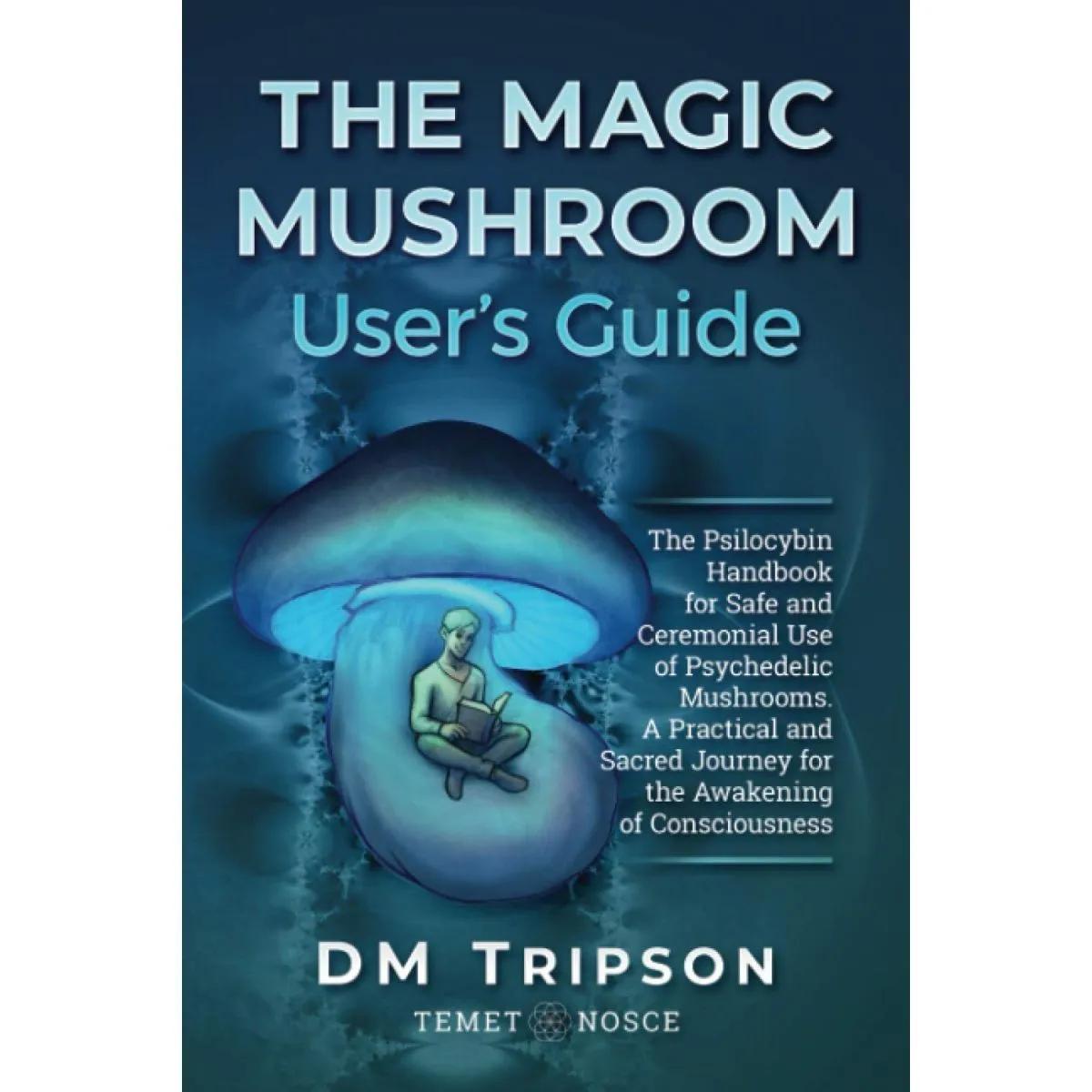
The Magic Mushroom User's Guide is a complete reference book covering the practical, ceremonial, and scientific dimensions of psilocybin mushrooms. Written by DM Tripson and available in both English and Italian, it walks you from the absolute basics — how much to take, mushrooms versus truffles, where to do it — right through to ancient traditions and modern clinical research. If you've ever wanted one book that covers the full picture without dumbing it down, this is the one we keep behind the counter.
| Edition | SKU | Best For |
|---|---|---|
| English | HS1381 | Native English speakers and anyone comfortable reading in English |
| Italian | HS1382 | Native Italian speakers or those studying Italian terminology around psilocybin |
Both editions contain identical content — same structure, same depth. Pick whichever language you'll actually sit down and read cover to cover.
The book is split into three distinct parts, each building on the last. That structure matters because most psilocybin guides either stay surface-level or jump straight into heavy theory. DM Tripson does neither — the progression feels natural, like a conversation that gets deeper as trust builds.
Part One handles the essentials. If you've never touched a mushroom or truffle in your life, this is where you start. It covers practical questions: dosing ranges (research commonly references microdoses of 0.1–0.3g, threshold doses around 0.5–1g, and moderate doses of 1–2.5g of dried material), the difference between psilocybin mushrooms and psilocybin truffles, setting selection, and what to expect during the hours that follow. No fluff, just the information you actually need before your first time.
Part Two expands on those fundamentals. It moves beyond "how" into "why" — explaining the reasoning behind best practices. Why an empty stomach matters for onset timing. Why set and setting aren't just clichés but measurable variables that shape the entire experience. Why patience at the 60-minute mark prevents the classic redosing mistake we hear about in the shop at least twice a week.
Part Three is where it gets properly interesting. Tripson draws connections between ancient ceremonial use of psilocybin mushrooms — traditions stretching back thousands of years — and what modern science is now confirming in clinical settings. According to a 2022 systematic review published in Cureus, psilocybin has what researchers describe as the best safety profile of any substance in its class, with low physiological toxicity (PMC9650681). The parallels between what indigenous cultures knew intuitively and what controlled trials are measuring today make for genuinely compelling reading.
We've stocked a fair number of books about psychedelics over the years. Most fall into one of two camps: either they're written for academics and read like a pharmacology textbook, or they're so vague and "spiritual" that you finish them knowing less than when you started. The Magic Mushroom User's Guide sits in that rare middle ground — rigorous enough to cite, accessible enough to read in an afternoon.
What we appreciate most is the honesty. Tripson doesn't pretend psilocybin is a magic bullet. The book acknowledges that experiences vary, that preparation matters enormously, and that not every session will be comfortable. According to research published in PMC, common adverse effects of psilocybin include anxiety, nausea, pupillary dilation, yawning, and transient increases in heart rate and blood pressure (PMC9650681). The book doesn't shy away from this — it addresses it head-on and gives you tools to navigate it.
The one honest limitation: it's a book, not a field guide for mushroom identification. If you're looking for spore prints and cap measurements, you'll want a mycology-specific reference alongside this one. What Tripson does better than anyone is the human side — the preparation, the experience itself, and the integration afterwards.
Part Three of the book digs into the growing body of clinical research around psilocybin, and there's a lot to dig into. According to a 2023 study in PMC, psilocybin — the main psychoactive component found in hundreds of species — has garnered significant scientific interest and positive research outcomes across multiple conditions (PMC11920119).
Research is moving fast. According to a systematic review in the Journal of Integrative Medicine, clinical trials have observed psilocybin's potential therapeutic effects across several areas, with the substance demonstrating a favourable safety profile in controlled settings (PMC9650681). A separate review examining psilocybin's impact on patients experiencing existential distress noted promising results in palliative care contexts (PMC10306375). And a 2024 evaluation in PMC described the substance as the subject of intense scientific and popular interest, with multiple Phase II and Phase III trials underway (PMC11016263).
The book contextualises all of this without overstating it. Tripson is careful to present research findings as exactly that — findings, not guarantees. That's the right approach, and it's why we're comfortable recommending this to sceptics as well as enthusiasts.
One thing worth noting from the safety literature: psilocybin can interact badly with other substances, particularly stimulants, other psychoactive compounds, and MAOIs. A case report highlighted the potential danger of combining psilocybin mushrooms with MAOIs and stimulants, resulting in hypertensive emergency. The book covers interaction risks — another reason it's worth reading before, not after, your first experience.
| Spec | Detail |
|---|---|
| Author | DM Tripson |
| Available Languages | English (HS1381), Italian (HS1382) |
| Structure | Three parts: Essentials, Best Practice, Ceremony and Science |
| Audience | Complete beginners through to experienced users |
| Topics Covered | Dosing, set and setting, mushrooms vs truffles, ceremonial history, clinical research |
| Format | Physical book |
| Category | Books and Gifts |
Reading about psilocybin truffles and want to try them yourself? Pair this book with one of our fresh psilocybin truffle packs — the Mexicana is a solid starting point for first-timers, and the Hollandia is where experienced users tend to gravitate. A precision scale accurate to 0.01g is also worth picking up so you can measure doses exactly as the book recommends.
We've been selling truffles and mushroom grow kits since 1999. In that time, the single biggest predictor of a good experience isn't the strain, the dose, or even the setting — it's preparation. People who've read up, who understand what's happening in their body and brain, who know what a 0.5g threshold dose feels like versus a 2.5g moderate dose, consistently have better outcomes. That's not opinion — it's 25 years of watching people walk back into the shop the next week either glowing or shaken.
The Magic Mushroom User's Guide gives you that preparation in one place. No trawling through Reddit threads of varying quality. No piecing together contradictory forum posts from 2009. One book, structured logically, written by someone who clearly knows the territory.
And if you're already experienced? Part Three alone justifies the purchase. The ceremonial history is fascinating, and the way Tripson maps ancient practices onto modern clinical protocols makes you see both in a completely different light. According to research in PMC, a 2014 case report documented a patient with treatment-resistant OCD who responded to psilocybin after multiple medication failures (PMC6007659) — the kind of finding that echoes what traditional practitioners observed centuries ago without the language of clinical trials.
Yes. Part One is specifically written for people with zero experience. It covers the most basic questions — what to expect, how much to take, mushrooms versus truffles — before anything more advanced. You won't feel lost.
It does. Tripson addresses the differences between mushrooms and truffles directly, including potency variations and practical considerations for each. Both are covered throughout the three sections.
The book covers the full spectrum from microdoses (commonly referenced in research as 0.1–0.3g) through moderate doses (1–2.5g) and beyond. Dosing context is grounded in clinical research ranges rather than personal anecdote, which makes it more reliable than most online sources.
Yes. It addresses common adverse effects including nausea, anxiety, and transient cardiovascular changes. It also covers interactions with other substances — particularly the risks of combining psilocybin with MAOIs and stimulants, which can cause serious complications.
The content is identical. The English edition (HS1381) and Italian edition (HS1382) contain the same three-part structure, the same research citations, and the same practical guidance. Choose based on your reading language preference.
Part Three is dedicated to it. Tripson covers modern clinical findings — including research into psilocybin's safety profile and therapeutic potential — alongside ancient ceremonial practices, drawing direct parallels between the two.
It's written with sceptics in mind. The scientific sections cite published clinical research rather than relying on anecdote. According to a 2024 review in PMC, psilocybin has been the subject of rigorous clinical evaluation with promising outcomes across multiple conditions. The evidence speaks for itself.
Last updated: April 2026