
Cet article traite de substances psychoactives destinées aux adultes (18+). Consultez un médecin si vous avez une pathologie ou prenez des médicaments. Notre politique d'âge
Grandmas Trying Magic Mushrooms for the First Time
Definition
Cut filmed three grandmas trying psilocybin mushrooms — the natural follow-up to their viral cannabis-grandmas video. The format is the same; the substance is heavier.
"3 Grandmas Trip on Magic Mushrooms for the First Time" is the psychedelic counterpart to Cut's wildly popular cannabis-grandmas video, filmed by the same Seattle-based YouTube channel that quietly shifted public conversation about cannabis a decade earlier. Three older women sit down on camera, take a measured dose of psilocybin mushrooms, and let the camera roll. The video is age-restricted on YouTube — which means it can't be embedded directly — but the thumbnail and link below take you straight to it. If you remember the cannabis original, you already know the format. The substance is just heavier.
Why Cut's Magic Mushroom Grandmas Video Hits a Different Register Than the Cannabis One
The cannabis-grandmas video worked because its three grandmothers were trying something that, in 2014, had just become legal in their home state and was rapidly normalising across the United States. The arc was short, the stakes were low, and the worst-case scenario was a giggling fit and a bag of crisps. The magic-mushrooms version is a different proposition entirely.
Psilocybin mushrooms are not a giggle. They can be — particularly at lower doses in the right setting — but the substance produces meaningful changes in perception, time sense, and emotional intensity that last several hours. A cannabis high is a 60-to-90-minute curve. A psilocybin trip is a four-to-six-hour event. That different timescale changes everything: how the participants prepare, how the conversation evolves, what comes up, and what stays with them afterwards.
What is consistent across both videos is Cut's house style. No script. No safety net beyond a sensible team in the room. Real participants. Real reactions. Cameras that catch the moments most channels would edit out — the long pauses, the changes in posture, the quiet shift when the substance starts to work.
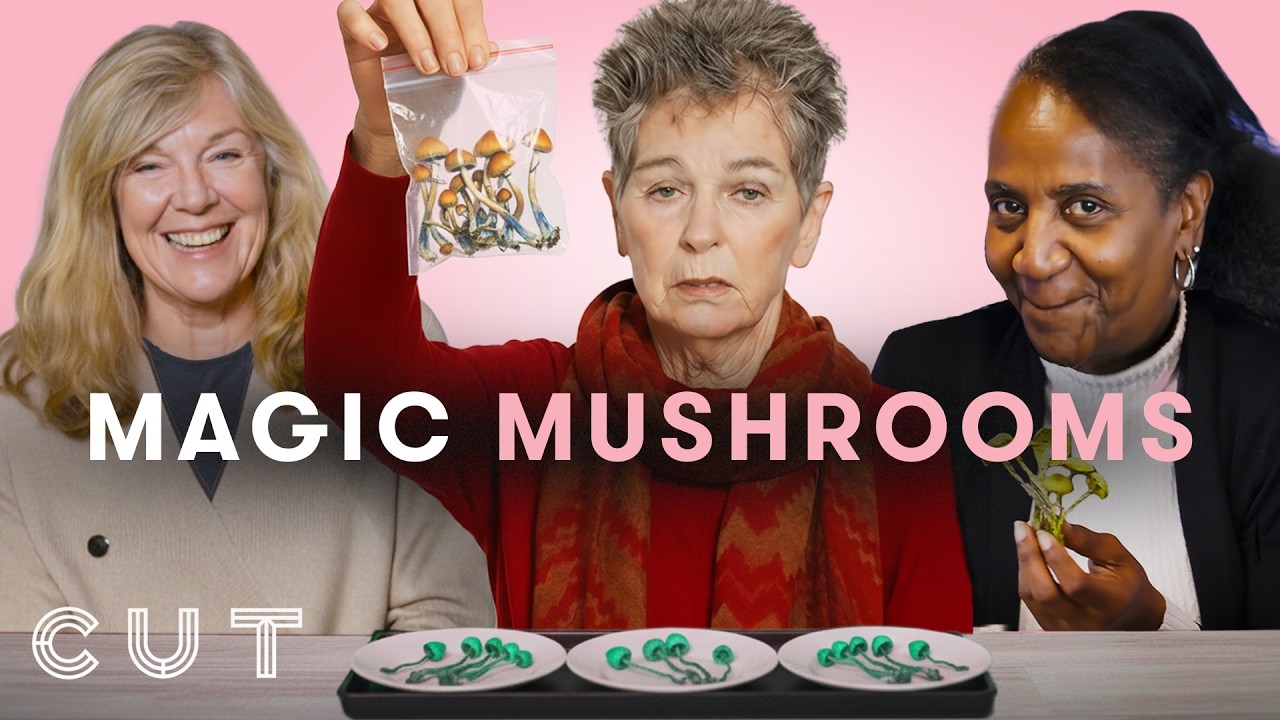
Because the video is age-restricted on YouTube, embedding it directly inside another page doesn't work — the player refuses to load anywhere except on YouTube itself, where viewers have to be signed in and confirmed as 18+. That is why the thumbnail above is a click-through, not an embed. It's the standard workaround for any restricted YouTube content, and it keeps the page accessible to readers who haven't logged in.
What Actually Happens in a First-Time Magic Mushroom Session — On Camera or Off
Whether you're watching three grandmas, three students, or yourself in a journal entry, the arc of a first-time psilocybin session is more predictable than the substance's reputation suggests. There is a build-up, a peak, a plateau, and a comedown — and the broad shape is the same regardless of who's holding the dose.
The first 20 to 40 minutes after ingestion are usually quiet. People feel a little nervous, sometimes a little nauseous, and conversation tends to stay surface-level. This is the longest part of the experience for first-timers because nothing seems to be happening yet — and that vacuum of expectation is exactly when the substance starts to ramp.
From around the 45-minute mark onward, perceptual changes start showing up. Patterns on fabric become more interesting. Light and colour feel slightly more vivid. Music sounds bigger. Most people describe an emotional softening — boundaries between thought and feeling blur, and small things become more noticeable. For a video crew, this is the moment where the camera starts catching genuine reactions rather than performative ones.
The peak — typically 90 minutes to 3 hours after dosing — is where the experience does most of its work. Visual closed-eye imagery, time dilation, and what most people call "open emotional state" are the hallmarks. Conversations get more honest. Memories surface. A sentence that started light can take an unexpected turn. The Cut format — three friends, no script, real reactions — is exactly the kind of setup where this part of the curve becomes television.
After 3 to 4 hours the experience starts to soften, and by hour 5 most first-timers are back to baseline-with-residue: more reflective than usual, sometimes tired, often visibly relieved that the thing they had been a little anxious about is now behind them. The Cut team almost certainly stopped filming long before the participants stopped feeling it.
Set, Setting, and Why Older First-Timers Often Have Smoother Sessions
One of the more interesting findings in modern psilocybin research is that older participants tend to report calmer, more meaningful experiences than younger ones. Studies at Johns Hopkins University, Imperial College London, and NYU have all documented this pattern across their psilocybin trial cohorts: people in their 50s, 60s, and 70s typically experience less anxiety and more "openness" than people in their teens or twenties, given the same dose and setting.
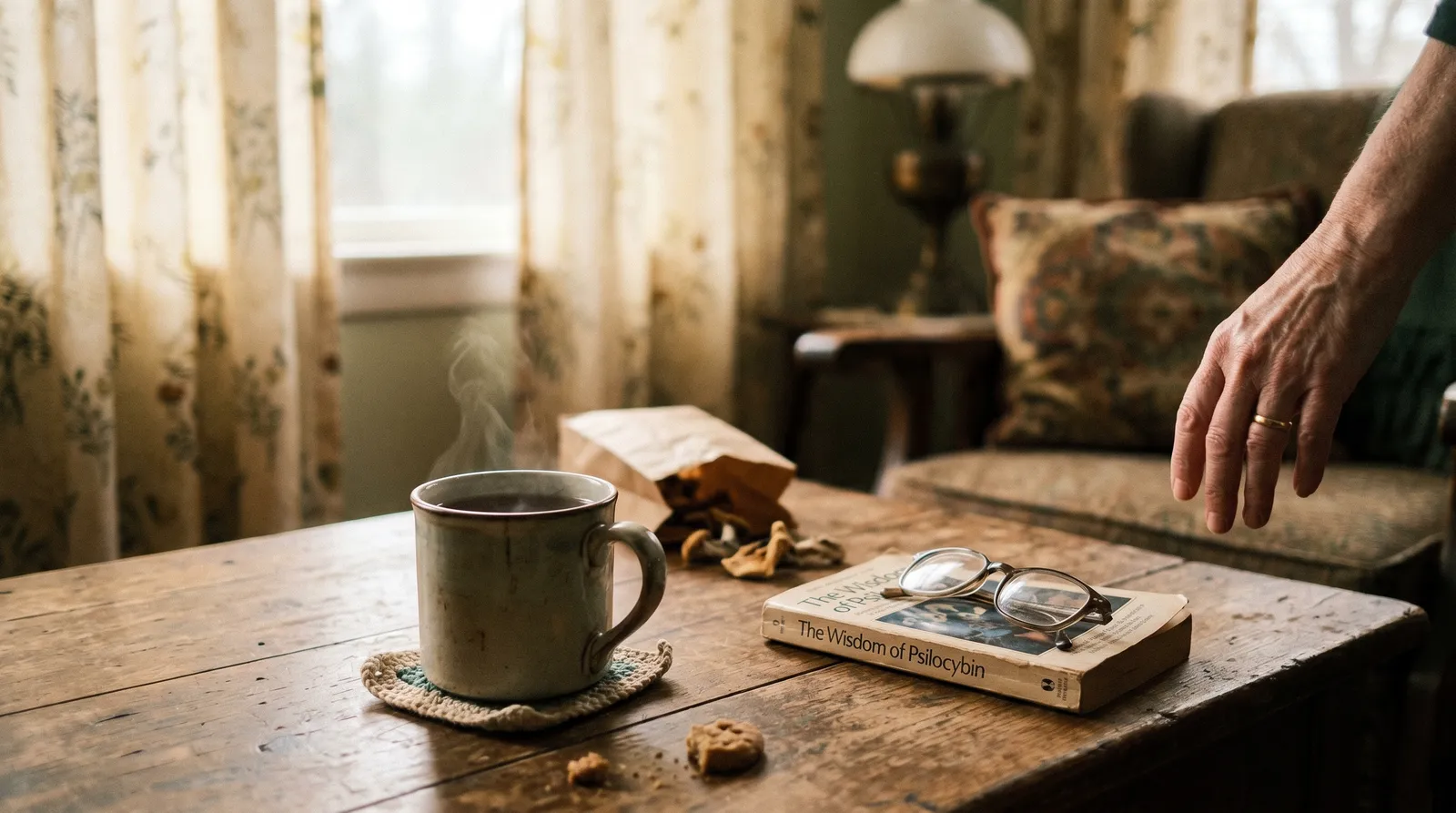
The leading hypothesis is that "set and setting" — the participant's mental state going in and the environment they're in — matters more than chronological age, and older participants often arrive with both in better shape. They have a clearer sense of why they're doing it. They're more comfortable in their own skin. They have less to prove. The room feels less like a test.
This is also why the Cut grandmas videos — both cannabis and mushrooms — work as content. Younger first-timers on camera can come across as performative; older first-timers tend to be quieter, more thoughtful, and funnier in the unintentional way that makes the moments land. The format rewards calm.
From Our Counter
We've been selling magic truffles in Amsterdam since the 1990s, which means we have had this exact pre-trip conversation thousands of times — including with people in their 60s, 70s, and a few in their 80s. Our advice doesn't change much by age: read up on dosage, take a smaller amount than you think you need, eat something light an hour before, and have a friend in the room who isn't dosing. The grandmas in the Cut video had a film crew handling the "trusted person" part. At home, that's a sober mate, a comfortable sofa, and a phone with a few calming playlists already queued.
How Cut's Magic-Mushroom Video Fits Into the Bigger Conversation
The cannabis-grandmas video did its cultural work in 2014, in the early years of US recreational legalisation, when cannabis still needed translation for a mainstream audience. The magic-mushroom video lands in a very different climate. Psilocybin is the substance that mainstream medicine is now studying most actively — for treatment-resistant depression, end-of-life anxiety, and addiction — and Oregon and Colorado have already passed regulated-access measures. The conversation has moved from "is this dangerous?" to "what should regulated access look like?"
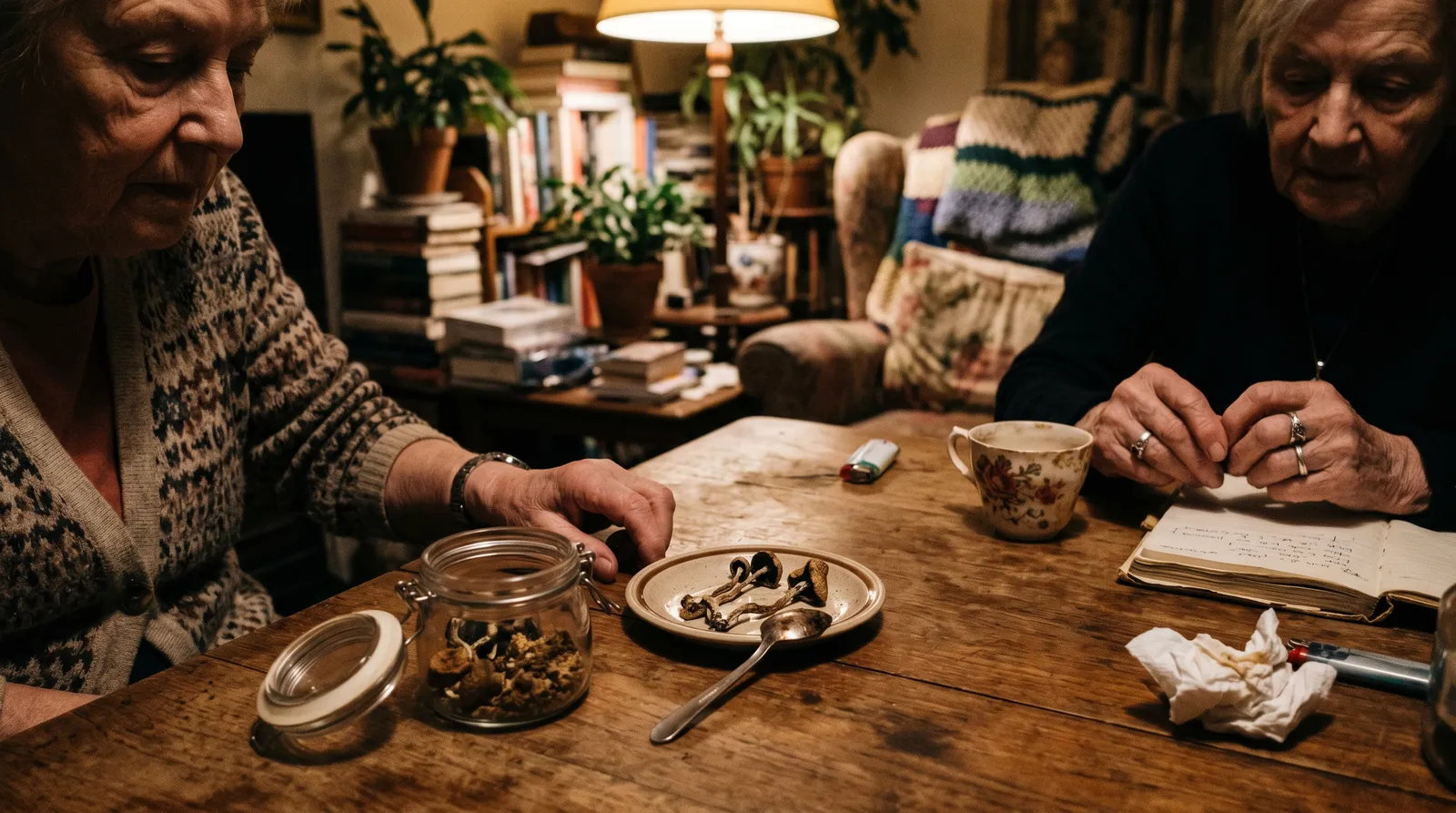
The video isn't a research tool, of course — it's an entertainment piece, the same way the cannabis original was. But the timing matters. People watching three grandmothers process a moderate psilocybin dose with curiosity rather than fear is a different cultural artefact in 2025 than it would have been in 2005. It signals that the substance is becoming legible to a broader public, the same way cannabis did a decade ago.
What the format doesn't do — and shouldn't — is replace research, dosing guidance, or honest harm reduction. A five-minute video can't teach you set and setting. It can show you that a psilocybin session can be calm, structured, and human, which is a useful counterweight to the cultural shorthand of psychedelics as chaos.
If the Video Sparked Your Curiosity: Where to Read Next
For anyone who finished the Cut video and felt curious rather than convinced, the most useful next step isn't another YouTube clip — it's a longer-form read on what psilocybin mushrooms (or magic truffles) actually do, what a sensible first dose looks like, and what set and setting really means in practice. Our wiki covers each of those threads in detail, written from a harm-reduction angle rather than a hype angle.

For most readers in the EU, magic truffles are the more practical entry point: legal in the Netherlands, available by post across the EU from Azarius, and broadly comparable in effect to mushrooms at equivalent doses. The truffles section of our wiki walks through dosing, varieties, set and setting, and what to do if a session gets bumpy.
From Our Counter
The single most common question we get from first-timers — older or younger — is some version of "how do I know if I'm taking too much?" The honest answer is that you don't, the first time. That's why the standard advice is start low (around 5–10 g of fresh truffles for an adult, or roughly 1–1.5 g of dried mushrooms), wait the full 60 minutes before considering more, and pick a setting where the worst-case scenario is "I'd rather be home." Most people who follow that pattern look back on a first session as memorable rather than overwhelming. The Cut format compresses all of that into five minutes of edited video — at home, give yourself a five-hour afternoon.
Last updated: April 2026
Questions fréquentes
6 questionsWhere can I watch the grandmas magic mushrooms video?
Is the magic mushrooms grandmas video real?
Why is the grandmas magic mushrooms video age-restricted?
How long does a magic mushroom trip last for first-timers?
Are magic mushrooms safer for older first-timers?
Can I buy magic mushrooms in Amsterdam?
À propos de cet article

Adam Parsons is an external cannabis and psychedelics writer and editor who contributes to Azarius's wiki as both author and reviewer. On the writing side, he authors Azarius's kratom and kanna clusters, drawing on exten
Cet article de blog a été rédigé avec l’aide de l’IA et relu par Adam Parsons, External contributor. Supervision éditoriale par Joshua Askew.
Dernière relecture le 26 avril 2026