
Cet article traite de substances psychoactives destinées aux adultes (18+). Consultez un médecin si vous avez une pathologie ou prenez des médicaments. Notre politique d'âge
How To Choose the Right Vaporizer
Definition
How To Choose the Right Vaporizer is a buyer's guide that walks through the five decisions shaping vaporizer selection: material type, heating method, portability, temperature control, and budget, grounded in vaporisation research (Hazekamp et al., 2006).
What Actually Matters When Picking a Vaporizer
This guide is written for adults aged 18 and over. The information below applies to adult physiology and adult decision-making.
Choosing the right vaporizer comes down to five things: what you want to vaporise, how you want to heat it, where you plan to use it, how much temperature control you need, and what you can spend. Everything else — brand loyalty, colour options, Bluetooth connectivity — is noise. A 2007 study using the Volcano Medic found that vaporisation at 200°C delivered cannabinoids while producing significantly fewer combustion byproducts than smoking (Hazekamp et al., 2006). That single finding shaped the entire modern vaporizer market. Below, we walk through each decision step so you end up with something you actually use instead of something that collects dust in a drawer.
Step 1 — Decide What You Want to Vaporise
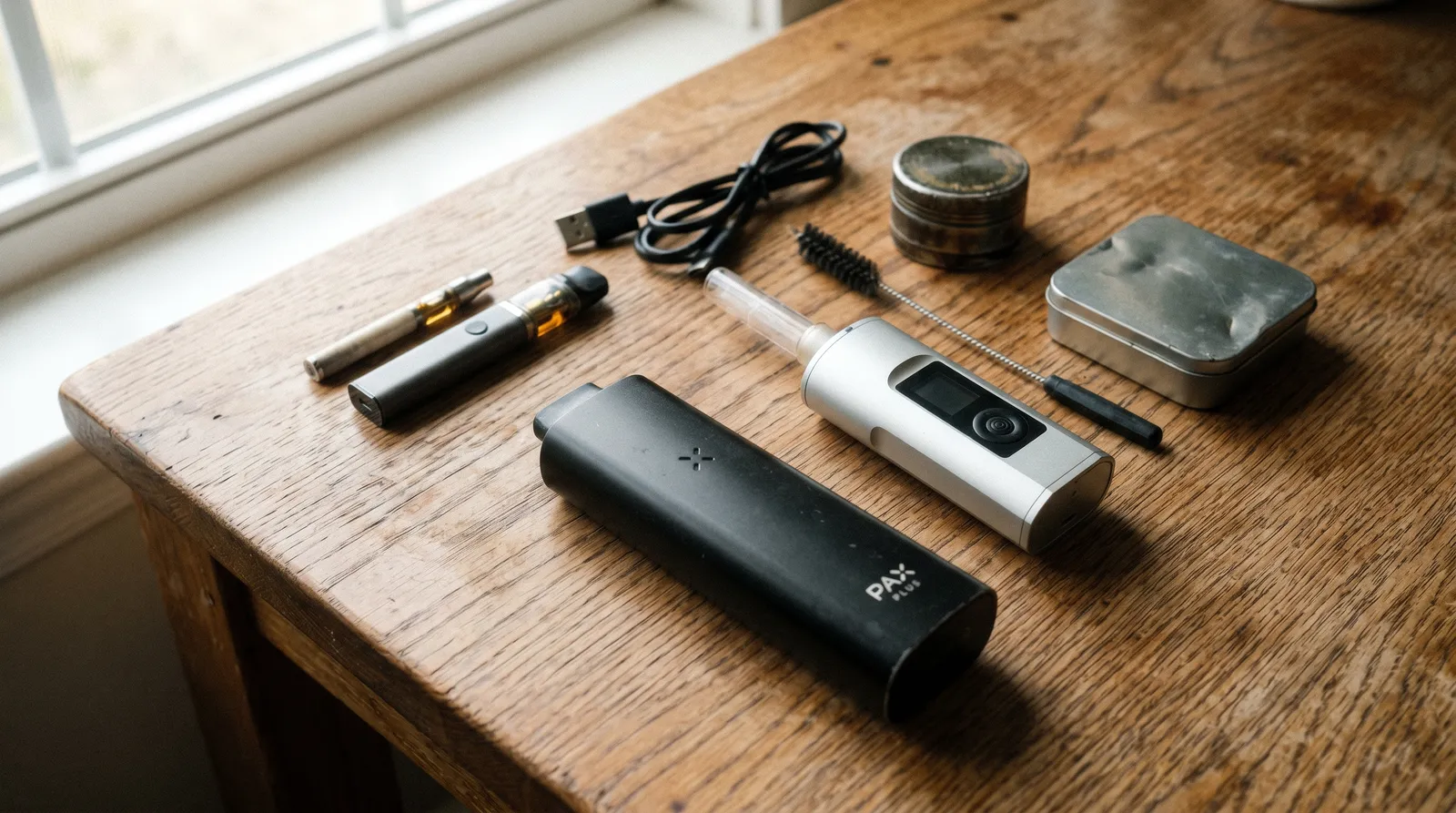
This is the fork in the road. Vaporizers are built around one of three material types, and most devices handle only one well.
Dry herb vaporizers heat ground botanical material — cannabis flower, damiana, blue lotus, lavender, or any other vapeable herb. The chamber holds loose plant matter and heats it to release active compounds as vapour. You taste the terpene profile directly, and you can adjust temperature to target specific compounds. If you care about flavour and the full spectrum of what a plant contains, this is where you start.
Concentrate vaporizers (also called wax pens or dab pens) are designed for extracts — waxes, shatters, rosins, and other concentrated forms. They use a small coil or ceramic dish that heats to higher temperatures. The vapour is denser and more potent per puff. These devices tend to be simpler and cheaper, but they only work with concentrates.
Oil/cartridge vaporizers use pre-filled or refillable cartridges containing liquid extracts. They are the most discreet and the easiest to use — screw on a cartridge, press a button, inhale. The trade-off is less control over what is in the oil and fewer options for adjusting your experience.
Some devices claim to handle two or all three material types. In practice, hybrid vaporizers usually do one thing well and the rest poorly. A device with a separate dry herb chamber and a concentrate insert can work, but the compromises in airflow and heating tend to show. If you vaporise both herbs and concentrates regularly, two dedicated devices will outperform one hybrid.
Step 2 — Choose Your Heating Method
How a vaporizer heats your material changes the flavour, efficiency, and consistency of each session. There are two main approaches, and a third that splits the difference.
Conduction heating works like a frying pan — the herb sits directly on a heated surface. Conduction vaporizers heat up fast (often under 30 seconds) and tend to be cheaper. The downside: uneven heating. The material touching the walls gets hotter than the material in the centre, which can lead to partial combustion at the edges while the middle stays under-extracted. Stirring the chamber between draws helps, but it is a hassle.
Convection heating works like a fan oven — hot air passes through the herb. Because the air circulates around and through the material, extraction is more even. Flavour is typically cleaner, and you waste less herb. Convection devices cost more and take longer to reach temperature (60–90 seconds is common), but the vapour quality is noticeably better. According to Pomahacova et al. (2009), convection-based devices delivered more consistent cannabinoid concentrations across successive draws compared to conduction models.
Hybrid heating combines both: a heated chamber wall plus hot air drawn through the material. This is what most mid-range to high-end portables use now. You get faster heat-up than pure convection with more even extraction than pure conduction. If you are spending above the budget tier, hybrid heating is usually what you will find.
Step 3 — Portable or Desktop
This sounds like a lifestyle question, but it is really a performance question.
Desktop vaporizers plug into the wall and stay on a table. They have larger heaters, better airflow, and unlimited power. A desktop like the Volcano (balloon-fill) or the Arizer Extreme Q (whip-style) produces thicker, cooler vapour than any portable can match. If you vaporise at home most of the time and care about vapour quality above all else, a desktop is the right call. They are also the format used in most clinical research — the Volcano Medic has been used in peer-reviewed studies since the mid-2000s.
Portable vaporizers run on rechargeable batteries and fit in a pocket or bag. Modern portables have closed the gap with desktops significantly — devices with hybrid heating and precision temperature control can produce genuinely good vapour. Battery life is the main constraint. Most portables deliver 4–8 sessions per charge, depending on temperature and session length. If you vaporise on the go, or simply do not want a tabletop appliance, a portable is the practical choice.
Pen-style vaporizers are the smallest portables. They work well for oil cartridges and concentrates but are generally too small to house a proper dry herb chamber. If someone hands you a "dry herb vape pen" for under €30, it is almost certainly a combustion device with a marketing problem.
| Factor | Desktop | Portable | Pen-style |
|---|---|---|---|
| Vapour quality | Best | Good to very good | Adequate (oils/concentrates only) |
| Temperature control | Precise (1°C increments common) | Good (preset or adjustable) | Limited (voltage-based) |
| Session length | Unlimited | 4–8 sessions per charge | Varies widely |
| Portability | None | Pocket or bag | |
| Price range | €150–€500+ | €80–€350 | €15–€80 |
| Best for | Home sessions, groups, medical use | Daily use, travel | Oil cartridges, quick draws |
Step 4 — Temperature Control and Why It Matters
Temperature is not a nice-to-have feature. It is the single biggest variable affecting what you inhale. Different compounds vaporise at different temperatures, and the gap between "flavourful vapour" and "burnt popcorn" can be as little as 15°C.
Most active compounds in cannabis and other herbs vaporise between 157°C and 220°C. Combustion — the thing you are trying to avoid — begins around 230°C. A 2004 study by Gieringer et al. found that vaporisation at 200°C produced a vapour-to-tar ratio significantly higher than combustion, meaning more active compound per unit of harmful byproduct (Gieringer et al., 2004).
Here is a rough guide to what happens at different temperature ranges, based on published boiling points for common cannabinoids and terpenes (data compiled from McPartland & Russo, 2001, and Hazekamp et al., 2006):
| Temperature range | Compounds released | Character of vapour |
|---|---|---|
| 157–175°C | THC (boils at ~157°C), pinene, myrcene, limonene | Light, flavourful, cerebral effects. Thin visible vapour. |
| 175–200°C | CBD (~180°C), CBN (~185°C), linalool, terpinolene | Fuller flavour, more balanced effects. Moderate visible vapour. |
| 200–220°C | CBC (~220°C), THCV (~220°C), caryophyllene, humulene | Denser vapour, stronger body effects. Flavour becomes more toasted. |
| 220°C+ | Approaching combustion threshold. Benzene detected above 230°C. | Harsh, diminishing returns. Risk of inhaling combustion byproducts. |
Vaporizers with precise digital temperature control (adjustable in 1°C increments) let you target specific ranges. Devices with preset temperatures (usually 3–5 settings) are simpler but less flexible. Either works — the critical thing is that the device has some form of temperature control. Avoid any vaporizer with a single fixed temperature or no temperature indication at all.
The Mighty by Storz & Bickel reads 182°C on its display, and a thermocouple probe stuck into the chamber reads 181°C. The cheap portable next to it on the test bench read 190°C and actually measured 214°C. Accurate temperature readout is worth paying for — the number on the screen means nothing if the sensor is poorly calibrated.
Step 5 — Features That Matter (and Features That Don't)
Features worth paying for:
- Isolated air path — The air you inhale should not pass over electronics or solder joints. Medical-grade devices use ceramic, stainless steel, or borosilicate glass air paths. This matters for your lungs more than any marketing claim about "pure vapour."
- Replaceable battery — Lithium-ion batteries degrade. A vaporizer with a sealed battery becomes e-waste when the cell dies. Removable 18650 cells cost a few euros to replace and extend the device's life by years.
- Easy cleaning — Resin builds up in the vapour path. If you cannot disassemble the mouthpiece and chamber for cleaning, you will eventually be inhaling through a clogged, stale tube. Devices with simple, tool-free disassembly get cleaned; devices that require tweezers and YouTube tutorials do not.
- Haptic or visual feedback — A vibration or LED change when the device reaches target temperature is genuinely useful. It means you are not guessing.
Features you can skip:
- Bluetooth/app control — Adjusting temperature from your phone sounds clever until the app gets discontinued or your phone dies. Physical controls work forever.
- Dosing capsules — Pre-loadable metal capsules keep the chamber clean and are convenient for on-the-go use. Useful, but not essential. Some people swear by them; others find them fiddly.
- Pass-through charging — Using the device while it charges is handy but puts stress on the battery and can affect temperature stability. Not a dealbreaker either way.
Step 6 — Set a Realistic Budget
Vaporizers range from €20 to €500+. The relationship between price and quality is not linear, but there is a floor below which you should not go.
Under €50: Almost exclusively conduction pen-style devices. Fine for oil cartridges. For dry herb, this price range rarely delivers true vaporisation — most of these devices combust the material, defeating the purpose. The materials used in the air path are also a concern at this price point.
€80–€150: The sweet spot for entry-level dry herb portables. Devices in this range from established manufacturers typically offer conduction or basic hybrid heating, preset temperature options, and decent build quality. The Xmax V3 Pro and Flowermate series live here.
€150–€300: Mid-range portables with hybrid heating, precise temperature control, and better materials. The Crafty+ and Arizer Solo II sit in this bracket. This is where most daily users find their long-term device.
€300+: High-end portables (Mighty+, Tinymight 2) and desktop vaporizers (Volcano, Arizer Extreme Q). If you vaporise daily and care about vapour quality, this tier pays for itself in efficiency — better extraction means less material used per session. A 2018 analysis by Lanz et al. found that efficient vaporizers extracted up to 77% of available THC from plant material, compared to roughly 25–50% from combustion (Lanz et al., 2004, updated methodology).
One honest point: we do not have long-term comparative data on whether the materials used in budget vaporizers (certain plastics, unspecified alloys) pose inhalation risks at operating temperatures. The absence of evidence is not evidence of absence. Spending more on a device with documented food-grade or medical-grade materials in the air path is a reasonable precaution, though the specific risk level of cheaper alternatives remains poorly studied.
Step 7 — First Session Basics
You have picked a device. Now what?
Burn-off run: Run the vaporizer at maximum temperature for one full heating cycle with an empty chamber before your first real session. This bakes off any manufacturing residues — machine oils, dust, off-gassing from new plastics. It will smell odd. That is the point.
Grind consistency: For dry herb vaporizers, a medium-fine grind works best. Too coarse and the hot air cannot reach the centre of each piece; too fine and the material packs too tightly, restricting airflow. A dedicated herb grinder set to a consistency slightly finer than rolled cigarette tobacco is about right.
Pack density: Fill the chamber fully but do not compress the material. A light tamp — just enough to level the surface — is sufficient. Overpacking restricts airflow and leads to uneven extraction. Underpacking in a conduction device means the material does not make proper contact with the heated walls.
Starting temperature: Clinical studies on cannabis vaporisation have commonly used temperatures between 170°C and 210°C (Abrams et al., 2007). Starting at the lower end of this range (around 170–180°C) lets you taste the terpenes first and gauge the effects before increasing. You can step up in 5–10°C increments across a session.
Draw technique: Slow, steady draws. This is not a cigarette — pulling hard cools the heater and reduces vapour production. A gentle 10–15 second draw gives the air time to pick up active compounds as it passes through the material.
Knowing when the bowl is done: The vapour thins out, flavour turns from herbal to toasted or slightly popcorn-like, and the material in the chamber looks uniformly dark brown. If it is black, you went too hot.
Cleaning and Maintenance
A dirty vaporizer delivers worse flavour, weaker vapour, and eventually stops working. Cleaning frequency depends on use, but a basic wipe-down of the chamber after every few sessions and a thorough clean weekly keeps most devices performing well.
Chamber: Brush out spent material while the device is still slightly warm (not hot) — residue comes off more easily. A small bristle brush, usually included with the device, is all you need.
Mouthpiece and screens: Soak in isopropyl alcohol (90%+) for 15–30 minutes, then rinse with warm water and let dry completely before reassembling. Resin buildup in the mouthpiece is the most common cause of restricted airflow.
Vapour path: For devices with a removable vapour path (glass stems, cooling units), the same isopropyl soak works. Some users save the reclaimed resin — it contains active compounds — though the flavour is not exactly pleasant.
Battery contacts: Wipe with a dry cotton swab if the device uses removable batteries. Dirty contacts cause poor connections and inconsistent heating.
Harm Reduction Notes
Vaporisation is not risk-free. It is a harm reduction strategy, not harm elimination.
A 2010 study published in the International Journal of Drug Policy found that regular cannabis users who switched to a vaporizer reported significant improvements in respiratory symptoms — less coughing, less phlegm, less chest tightness — within the first month (Van Dam & Earleywine, 2010). A separate analysis by Pomahacova et al. (2009) confirmed that balloon-collected vapour from a Volcano contained primarily cannabinoids and terpenes with dramatically reduced levels of carbon monoxide and tar compared to smoked cannabis.
That said, inhaling heated vapour still introduces foreign particles into your lungs. Long-term studies specifically on dry herb vaporisation are limited — most existing research covers periods of weeks to months, not decades. The 2015 NASEM report on cannabis noted that evidence for vaporisation reducing harmful byproducts was "moderate" but that long-term respiratory outcomes remained understudied (National Academies of Sciences, Engineering, and Medicine, 2017).
Practical harm reduction points:
- Stay below 220°C. Benzene, a known carcinogen, has been detected in vapour above 230°C (Gieringer et al., 2004).
- Clean your device regularly. Inhaling through accumulated resin is not the same as inhaling clean vapour.
- Use quality source material. Vaporising herb treated with pesticides or synthetic additives concentrates those contaminants in the vapour.
- Keep records of what temperature and how much material you use per session if you are trying to manage dosage — this is standard advice from clinical cannabis programmes (Grotenhermen, 2001).
Last updated: April 2026
Questions fréquentes
2 questionsWhat is the difference between conduction and convection vaporizers?
Is a dry herb vaporizer better than a concentrate or oil vaporizer?
À propos de cet article


Joshua Askew serves as Editorial Director for Azarius wiki content. He is Managing Director at Yuqo, a content agency specialising in cannabis, psychedelics and ethnobotanical editorial work across multiple languages. Th
Cet article wiki a été rédigé avec l’aide de l’IA et relu par Joshua Askew, Managing Director at Yuqo. Supervision éditoriale par Adam Parsons.
Avertissement médical. Ce contenu est fourni à titre informatif uniquement et ne constitue pas un avis médical. Consultez un professionnel de santé qualifié avant d'utiliser toute substance.
Dernière relecture le 24 avril 2026
References
- [1]Abrams, D.I. et al. (2007). Vaporization as a smokeless cannabis delivery system: a pilot study. Clinical Pharmacology & Therapeutics, 82(5), 572–578.
- [2]Gieringer, D., St. Laurent, J., & Goodrich, S. (2004). Cannabis vaporizer combines efficient delivery of THC with effective suppression of pyrolytic compounds. Journal of Cannabis Therapeutics, 4(1), 7–27.
- [3]Grotenhermen, F. (2001). Harm reduction associated with inhalation and oral administration of cannabis and THC. Journal of Cannabis Therapeutics, 1(3-4), 133–152.
- [4]Hazekamp, A. et al. (2006). Evaluation of a vaporizing device (Volcano) for the pulmonary administration of tetrahydrocannabinol. Journal of Pharmaceutical Sciences, 95(6), 1308–1317.
- [5]Lanz, C. et al. (2016). Medicinal cannabis: in vitro validation of vaporizers for the smoke-free inhalation of cannabis. PLoS ONE, 11(1), e0147286.
- [6]McPartland, J.M. & Russo, E.B. (2001). Cannabis and cannabis extracts: greater than the sum of their parts? Journal of Cannabis Therapeutics, 1(3-4), 103–132.
- [7]National Academies of Sciences, Engineering, and Medicine. (2017). The health effects of cannabis and cannabinoids. Washington, DC: The National Academies Press.
- [8]Pomahacova, B. et al. (2009). Cannabis smoke condensate III: the cannabinoid content of vaporised Cannabis sativa. Inhalation Toxicology, 21(13), 1108–1112.
- [9]Van Dam, N.T. & Earleywine, M. (2010). Pulmonary function in cannabis users: support for a clinical trial of the vaporizer. International Journal of Drug Policy, 21(6), 511–513.