
Cet article traite de substances psychoactives destinées aux adultes (18+). Consultez un médecin si vous avez une pathologie ou prenez des médicaments. Notre politique d'âge
How to Store Cannabis
Definition
Cannabis storage is a preservation practice that controls four variables — light, temperature, humidity, and air — to slow THC degradation and prevent mould. According to UNODC stability data (1999), cannabis stored at room temperature loses roughly 16–17% of its THC per year, with UV light being the single biggest degradation factor. This guide walks through each step to keep your flower, hash, or concentrates in peak condition.
Cannabis storage is a preservation practice that controls four environmental variables — light, temperature, humidity, and air exposure — to slow THC degradation and prevent mould growth on dried flower, hash, and concentrates. 18+ only — this guide is written for adults. The storage principles below apply to dried cannabis flower, hash, and concentrates kept for personal use.
Disclaimer: This article is provided for informational and harm-reduction purposes only. It does not constitute medical advice. Cannabis laws vary by jurisdiction — ensure you comply with your local regulations. If you are immunocompromised or have respiratory conditions, consult a healthcare professional before consuming stored cannabis of any age. Nothing on this page should be interpreted as encouragement to break any law.
Properly stored cannabis keeps its potency, flavour, and aroma for months — sometimes over a year. Badly stored cannabis loses THC, tastes like cardboard, and can develop mould that makes it genuinely unsafe to consume. The difference between the two comes down to knowing how to store cannabis by controlling four variables: light, temperature, humidity, and air exposure. None of them are difficult to manage once you understand how to store cannabis correctly.
A jar of supposedly "premium" flower came across our shop counter last summer, sealed in a clear glass jar that had been sitting on a windowsill for three months. It smelled like dried hay and crumbled to powder between two fingers. The trichomes were visibly oxidised — amber-brown instead of milky-white. Light and heat had done more damage in 90 days than years of proper dark storage would have.
Why Storage Matters: What Actually Degrades
THC doesn't just vanish — it converts into cannabinol (CBN), a far less psychoactive compound. When exposed to UV light, heat, or oxygen, delta-9-THC oxidises into CBN, which is associated with sedation rather than the effects you originally paid for. According to a United Nations Office on Drugs and Crime (UNODC) stability study (1999), cannabis stored at room temperature lost approximately 16.6% of its THC content over one year, while samples stored at higher temperatures degraded significantly faster. Terpenes — the volatile compounds responsible for smell and flavour — evaporate even more readily than cannabinoids, which is why old cannabis smells flat long before it tests as fully degraded.
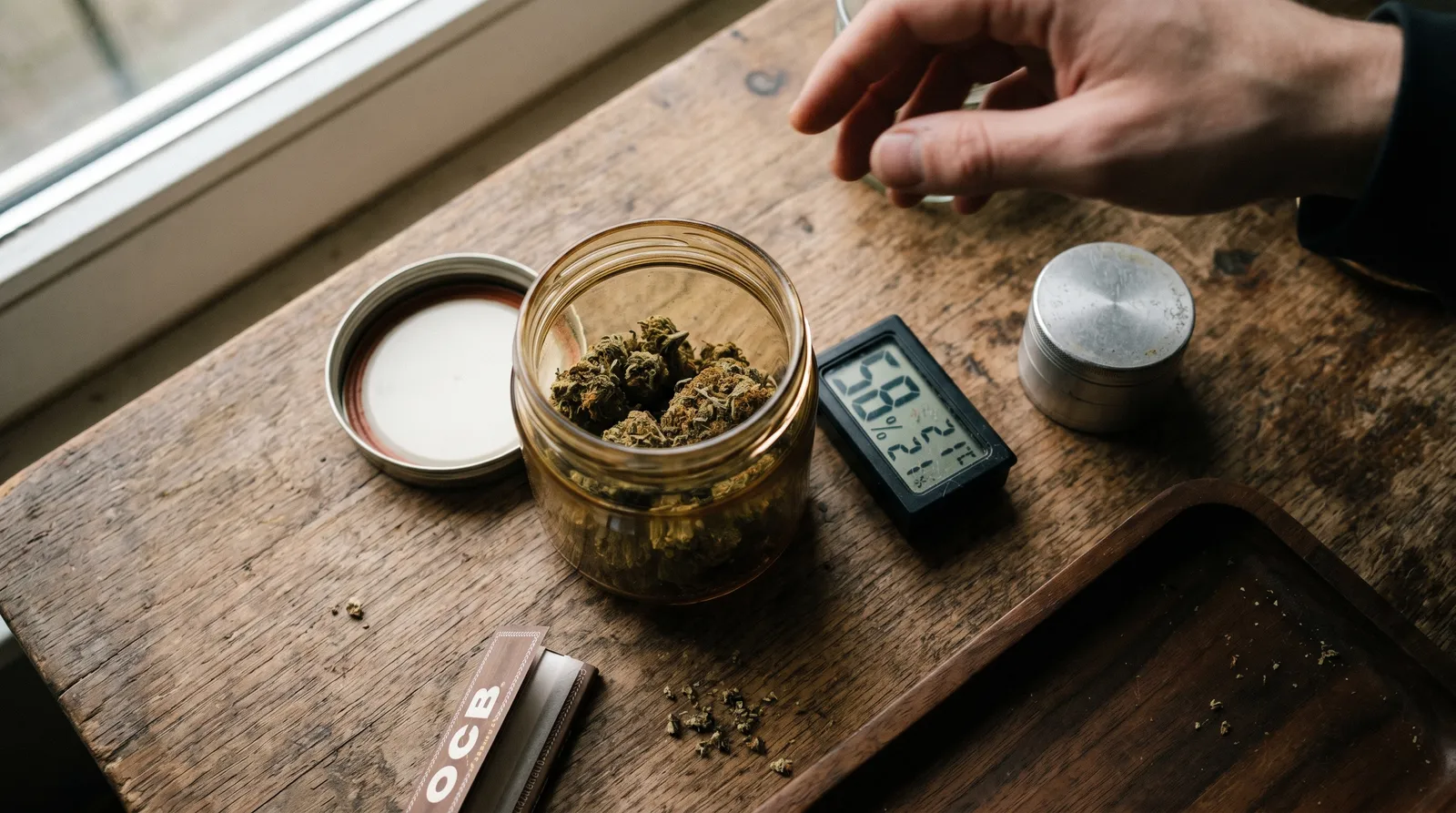
Moisture is the other enemy when you store cannabis without humidity control. Cannabis dried to a water activity (aw) below 0.65 is generally resistant to mould growth. Above 0.65 aw, Aspergillus and other fungi can colonise the flower. A 2017 analytical study published in Clinical Microbiology and Infection found that 20 out of 20 cannabis samples from dispensaries tested positive for some level of microbial contamination (Thompson et al., 2017). The European Monitoring Centre for Drugs and Drug Addiction (EMCDDA) has similarly noted that microbial contamination remains an underappreciated risk in cannabis products across Europe. While not all contamination is dangerous, immunocompromised users face real risk from Aspergillus fumigatus in particular.
The point: learning how to store cannabis properly isn't fussy perfectionism. It's the difference between usable cannabis and a health hazard.
Step 1 — Choose the Right Container
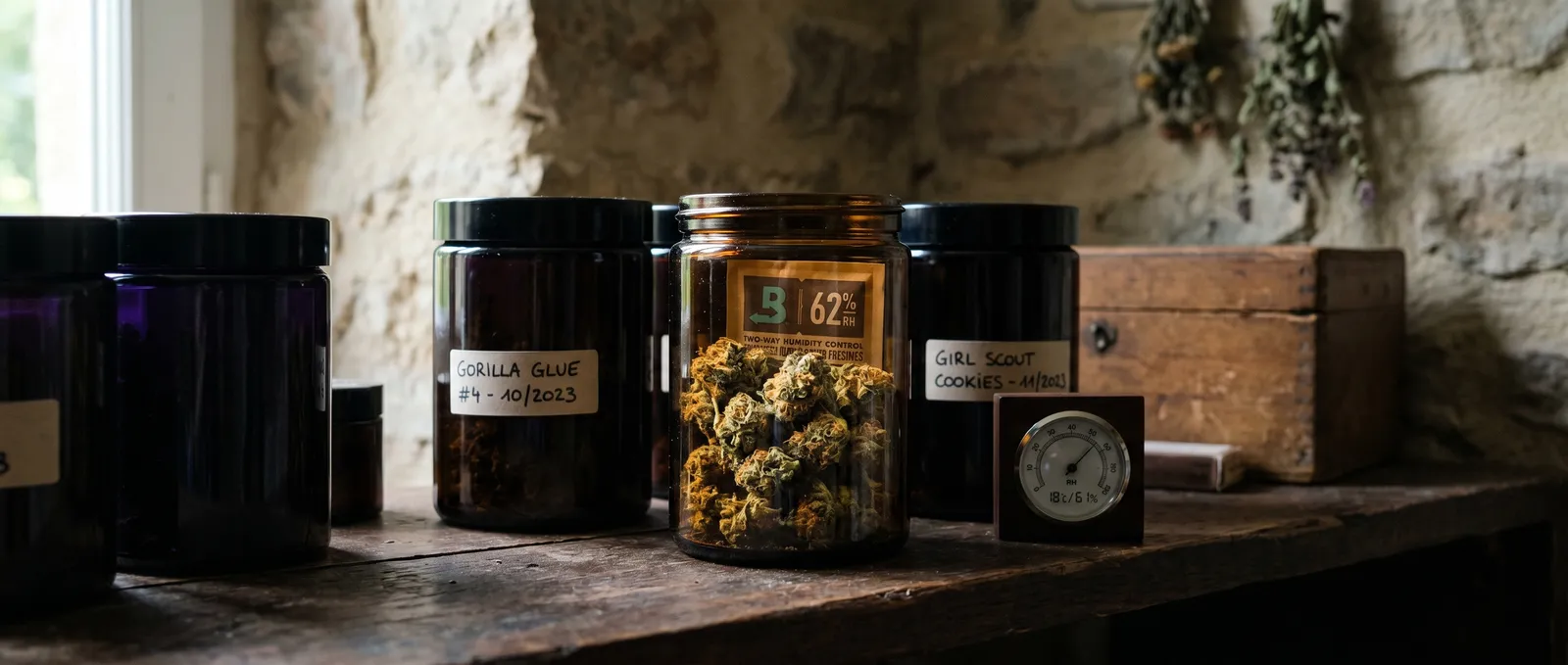
An airtight glass jar is the single best container for cannabis storage. Glass mason jars with airtight seals are the gold standard — they don't leach chemicals, they don't hold static charge (unlike plastic), and they seal properly. Wide-mouth jars in the 250–500ml range work well for most personal quantities — you want the jar roughly three-quarters full so there's minimal air trapped inside but enough room that the buds aren't crushed. You can buy quality Miron violet glass jars or simple amber mason jars from most headshops and online retailers — they're a small investment that pays for itself in preserved flower.
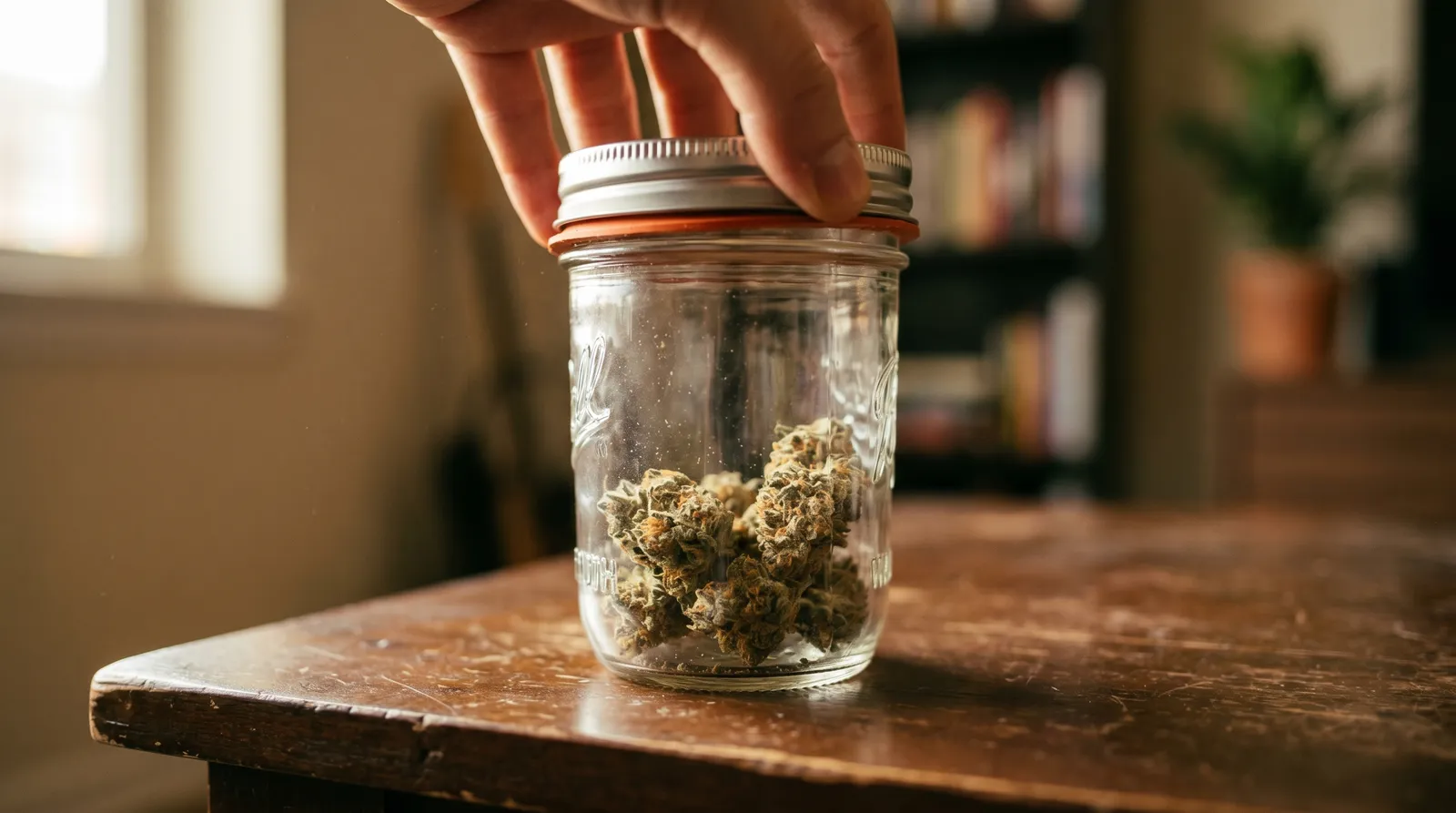
Avoid plastic bags and containers. Plastic carries static charge that pulls trichomes off the flower surface, and most plastic is slightly permeable to oxygen over time. Silicone containers are fine for concentrates and hash but poor for flower — the soft surface traps trichomes like Velcro.
Metal tins work in a pinch but can alter flavour over months. If you use one, line it with unbleached parchment paper.
Key point: one strain per jar. Mixing strains in a single container blends their terpene profiles into a generic muddle within a week or two. Knowing how to store cannabis means keeping each cultivar separate.
We've compared cannabis stored in cheap clip-top jars versus proper Miron violet glass over a three-month period. Honest assessment: the difference in the first month was negligible. By month three, the violet glass jar had noticeably more terpene aroma on opening. Whether that justifies the price difference depends on how long you typically store your supply — if you go through an ounce in two weeks, a basic mason jar is perfectly fine.
Step 2 — Control Humidity
The ideal relative humidity for cannabis storage is 55–62% inside the jar. Below 50% RH, trichomes become brittle and crumble off; the flower dries out, smokes harshly, and loses terpenes. Above 65% RH, you're creating conditions where mould can establish.
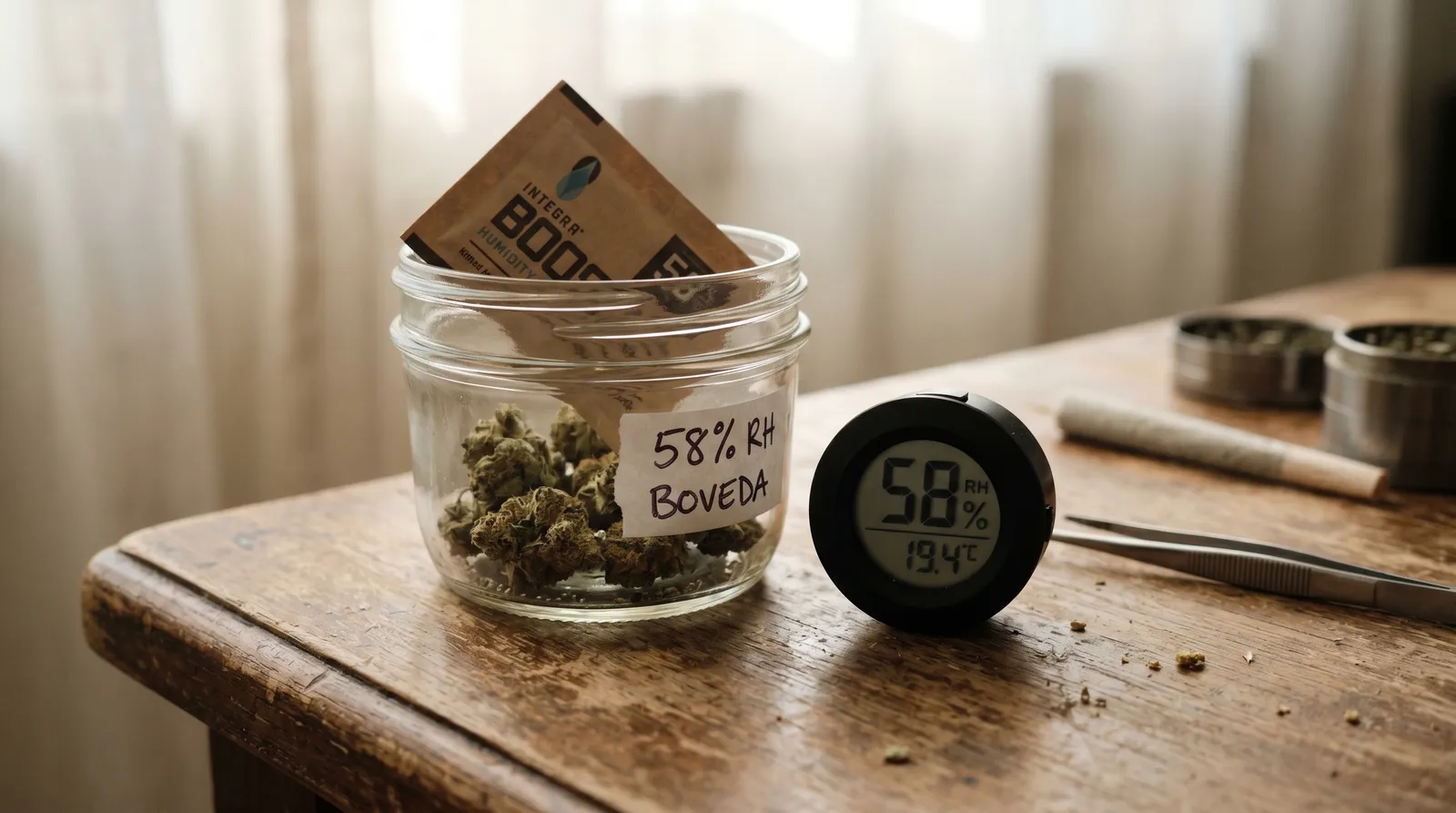
Two-way humidity control packs are the simplest solution. You can buy Boveda humidity packs or order Integra Boost sachets — typically rated at 58% or 62% RH — and drop one into your jar. The pack will either release or absorb moisture to maintain the set point. A single 8-gram pack handles roughly 15–30 grams of flower. Replace the pack when it turns rigid — that means it's exhausted.
If you don't have humidity packs, a small hygrometer inside a larger jar gives you a reading. Open the jar briefly if RH creeps above 62%; if it drops below 55%, the flower is probably over-dried and you'll need a humidity pack to rehydrate it slowly.
A word of caution: rehydrating cannabis with orange peel, lettuce, or bread (yes, people do this) introduces organic matter that can carry mould spores. A purpose-made humidity pack is safer and costs almost nothing. Anyone serious about how to store cannabis should avoid DIY rehydration methods entirely.
Step 3 — Block Light Completely
UV radiation is the single biggest driver of THC degradation in stored cannabis. The same UNODC study (1999) found that light exposure was the most significant factor in cannabinoid loss, more so than temperature alone. This is why cannabis has traditionally been stored in opaque or dark-coloured containers — amber glass, violet glass, or simply a clear jar kept inside a cupboard or box.
If you're using clear mason jars, store them inside a drawer, cupboard, or cardboard box. Wrapping a jar in a dark cloth or tape works too, though it's less elegant. The rule is straightforward: if light can reach the flower, THC is converting to CBN — and that's the opposite of how to store cannabis for lasting potency.
Violet glass (Miron glass) blocks the full visible light spectrum while allowing a narrow band of UV-A and violet light through — proponents claim this preserves bioactive compounds better than amber glass, though peer-reviewed data specifically comparing violet glass to amber glass for cannabis storage is limited. Amber glass blocks most UV and is widely available at a fraction of the cost.
Step 4 — Keep It Cool (But Not Cold)
The optimal temperature range for cannabis storage is 15–21°C. Below 15°C, trichomes become brittle and can snap off with handling. Above 25°C, terpene evaporation accelerates and you're creating a warmer, more mould-friendly environment — especially if humidity isn't controlled.
A cool, dark cupboard — the kind you'd store wine in — is ideal. Avoid the kitchen (temperature fluctuations from cooking), the bathroom (humidity spikes from showers), and anywhere near a radiator or south-facing window.
What about the fridge or freezer? Fridges cycle humidity constantly as the compressor kicks on and off, which can introduce condensation inside your jar every time you open it. Freezers preserve cannabinoids well for very long-term storage (6+ months), but frozen trichomes shatter like glass at the slightest touch — you'll lose potency to mechanical damage when handling the flower. If you do freeze, vacuum-seal first and don't handle the buds until they've returned to room temperature. For most people learning how to store cannabis for a few weeks to a few months, a cupboard is better than either.
Step 5 — Minimise Air Exposure
Oxygen drives oxidation, making airtight storage essential for anyone learning how to store cannabis long-term. Every time you open a jar, you're exchanging the air inside with fresh, oxygen-rich air. This is unavoidable if you're dipping into your supply regularly, but you can reduce the impact:
- Fill jars to roughly 75% capacity — less headspace means less trapped oxygen.
- If you have a large quantity, split it across multiple smaller jars. Keep one as your "daily driver" and leave the rest sealed.
- Vacuum sealing with a food-grade vacuum sealer is effective for long-term storage, though the compression can flatten buds and break trichomes if you're not careful. Use the gentle/pulse setting if your machine has one.
- Nitrogen-flushing (displacing oxygen with food-grade nitrogen before sealing) is used in commercial cannabis packaging. It's overkill for home storage, but if you happen to have a nitrogen canister from homebrewing, it works brilliantly.
Storing Hash and Concentrates
Hash and concentrates follow the same core principles — dark, cool, airtight — but each form has specific quirks worth knowing when you store cannabis in concentrated form:
- Traditional hash: wrap in unbleached parchment paper, then place in an airtight jar. Hash is more forgiving than flower because its lower moisture content and compressed form reduce surface area exposed to air. Well-made hash stored this way keeps for years — Moroccan and Afghan hash from the 1970s has been tested and found to retain measurable THC decades later, though terpene profiles shift considerably.
- Rosin and live resin: store in small glass or PTFE (non-stick) containers in the fridge. These concentrates are terpene-rich and degrade faster at room temperature. Let the container reach room temperature before opening to avoid condensation.
- Shatter and wax: parchment paper inside a sealed glass jar, stored cool. Shatter can "butter up" (lose its glassy consistency) in warm or humid conditions — this doesn't necessarily mean potency loss, but it changes the handling properties.
Essential Cannabis Storage Accessories
You don't need much to store cannabis properly, but a few accessories make a real difference. Here's what we recommend based on years of experience behind the counter:
- Airtight glass jars: Amber or violet glass in the 250–500ml range. Get one jar per strain you keep on hand. You can buy these from most smartshops or order them online.
- Boveda or Integra Boost humidity packs: Buy the 58% or 62% RH versions in 8-gram size. Order a few extras — they're consumable and need replacing every 2–4 months depending on how often you open the jar.
- Small digital hygrometer: Useful if you store cannabis in larger quantities or want to verify conditions. Not essential for a single jar with a humidity pack, but helpful for dialling in your setup.
- Vacuum sealer: Only necessary for long-term storage of several months or more. A basic food-grade model works fine.
We keep a small "storage starter kit" recommendation for customers who ask: one amber mason jar, one 8-gram Boveda 62% pack, and a strip of masking tape to label the strain and date. Total cost is minimal, and it covers 90% of what you need. The fancy stuff — Miron glass, vacuum sealers, hygrometers — is worth it if you store cannabis for months at a time, but most people do perfectly well with the basics. We're honest about that because overselling accessories helps nobody.
Violet Glass vs Amber Glass: A Practical Comparison
Both violet Miron glass and amber glass are widely recommended for cannabis storage, so here's our honest take based on what we've observed at the shop. Amber glass blocks roughly 99% of UV-B and UV-C radiation and most visible light — it's the same reason pharmacies use amber bottles. Violet Miron glass makes additional claims about "biophotonic" preservation, but the independent cannabis-specific research is thin. For most home users who store cannabis in a dark cupboard anyway, the glass colour matters less than simply keeping the jar out of light. If your jar lives in a drawer, save your money and get amber.
Honest limitation: we haven't conducted lab-tested cannabinoid analysis ourselves — our comparisons are based on aroma, appearance, and customer feedback over time. The UNODC data gives us the science; our counter experience gives us the practical nuance. Neither is a substitute for the other.
Common Mistakes
These are the cannabis storage errors we see most often — and every one of them is easily avoidable:
| Mistake | What Happens | Fix |
|---|---|---|
| Storing in a plastic baggie | Static pulls off trichomes; plastic is oxygen-permeable | Transfer to a glass jar with an airtight seal |
| Leaving the jar on a shelf in sunlight | UV converts THC to CBN; terpenes evaporate | Move to a dark cupboard or use opaque glass |
| Grinding in advance "for convenience" | Massively increased surface area accelerates oxidation and terpene loss | Grind only what you plan to use in the next session |
| Rehydrating with fruit peel | Introduces mould spores and sugars | Use a 62% RH two-way humidity pack |
| Opening the freezer jar repeatedly | Condensation forms on cold buds; trichomes shatter | Split into single-use portions before freezing |
| Storing near spices or strong-smelling items | Cannabis absorbs ambient odours through imperfect seals | Dedicated storage space away from kitchens |
How Long Does Stored Cannabis Last?
Properly stored cannabis flower retains the vast majority of its potency for 6–12 months. With airtight glass, 58–62% RH, 15–21°C, and total darkness, degradation is slow and predictable. The UNODC data (1999) showed roughly 16–17% THC loss per year at room temperature in the dark. In practice, most people notice flavour degradation before potency loss — terpenes are more volatile than cannabinoids, so the flower starts tasting flat around the 4–6 month mark even when you store cannabis well.
After 12 months, THC conversion to CBN becomes more noticeable. The flower won't be dangerous (assuming no mould), but it'll be sleepier and less flavourful. After 2+ years, you're looking at significant potency reduction regardless of how carefully you store cannabis.
Hash lasts longer — its compressed, low-moisture form is inherently more stable. Properly stored traditional hash can remain potent for several years, though the terpene profile shifts over time toward earthier, more muted notes.
We once tested a customer's two-year-old flower that had been stored in a sealed Miron jar with a Boveda pack in a basement cupboard. It was noticeably less aromatic than fresh flower, and the high leaned more sedative — classic CBN conversion. But it was still perfectly smokeable and far better than the three-month windowsill disaster we mentioned at the top. Storage doesn't stop time, but it buys you a lot of it.
Quick Reference: Ideal Cannabis Storage Conditions
| Parameter | Target Range | Why |
|---|---|---|
| Temperature | 15–21°C | Slows degradation without making trichomes brittle |
| Relative humidity | 55–62% | Prevents mould (below 65%) while keeping flower supple (above 50%) |
| Light exposure | Zero (total darkness) | UV is the primary driver of THC-to-CBN conversion |
| Air exposure | Minimal (airtight seal, 75% jar fill) | Oxygen drives oxidation of cannabinoids and terpenes |
| Container material | Glass (amber or violet preferred) | No static, no permeability, no chemical leaching |
Related Categories and Further Reading
If you're setting up a proper cannabis storage system, you may also want to browse our selection of storage jars and containers in the Azarius smartshop accessories category. Our vaporizer wiki article covers how proper storage improves vapour quality, and the Azarius blog features seasonal guides on humidity control for European climates. The cannabis grinder product category is also worth exploring — a quality grinder pairs well with good storage habits since you should only grind what you need per session.
Last updated: April 2026
Questions fréquentes
8 questionsDoes cannabis go bad or expire?
Should I store cannabis in the fridge or freezer?
What humidity level is best for storing cannabis?
Can I use plastic bags to store cannabis?
How can I tell if stored cannabis has gone mouldy?
Where can I buy cannabis storage jars and humidity packs?
How long does cannabis stay potent when stored properly?
Does light or heat cause more damage to stored cannabis?
À propos de cet article


Joshua Askew serves as Editorial Director for Azarius wiki content. He is Managing Director at Yuqo, a content agency specialising in cannabis, psychedelics and ethnobotanical editorial work across multiple languages. Th
Cet article wiki a été rédigé avec l’aide de l’IA et relu par Joshua Askew, Managing Director at Yuqo. Supervision éditoriale par Adam Parsons.
Avertissement médical. Ce contenu est fourni à titre informatif uniquement et ne constitue pas un avis médical. Consultez un professionnel de santé qualifié avant d'utiliser toute substance.
Dernière relecture le 24 avril 2026
References
- [1]United Nations Office on Drugs and Crime (UNODC). (1999). Recommended Methods for Testing Cannabis. Stability data on THC degradation under varying light and temperature conditions.
- [2]Thompson, G. R. et al. (2017). A microbiome assessment of medical marijuana. Clinical Microbiology and Infection, 23(4), 269–270.
- [3]Trofin, I. G. et al. (2012). Long-term storage and cannabis oil stability. Revista de Chimie, 63(3), 293–297.
- [4]European Monitoring Centre for Drugs and Drug Addiction (EMCDDA). (2019). Cannabis legislation in Europe: an overview. Lisbon: EMCDDA. Includes discussion of product quality and contamination risks across European markets.
- [5]Beckley Foundation. (2016). Cannabis Policy: Moving Beyond Stalemate. Oxford: Beckley Foundation. Provides broader context on cannabis quality standards and harm-reduction frameworks relevant to storage and consumer safety.